Awesome illustrators and printmakers
Raiding history for clip art
2014-08-31 — 2026-06-21
Wherein a Personal Canon of Engravers and Caricaturists Is Surveyed, From Dürer’s Armoured Rhinoceros to Gillray’s Tiny Bonaparte, With Links to Rijksmuseum and Other Public Collections.
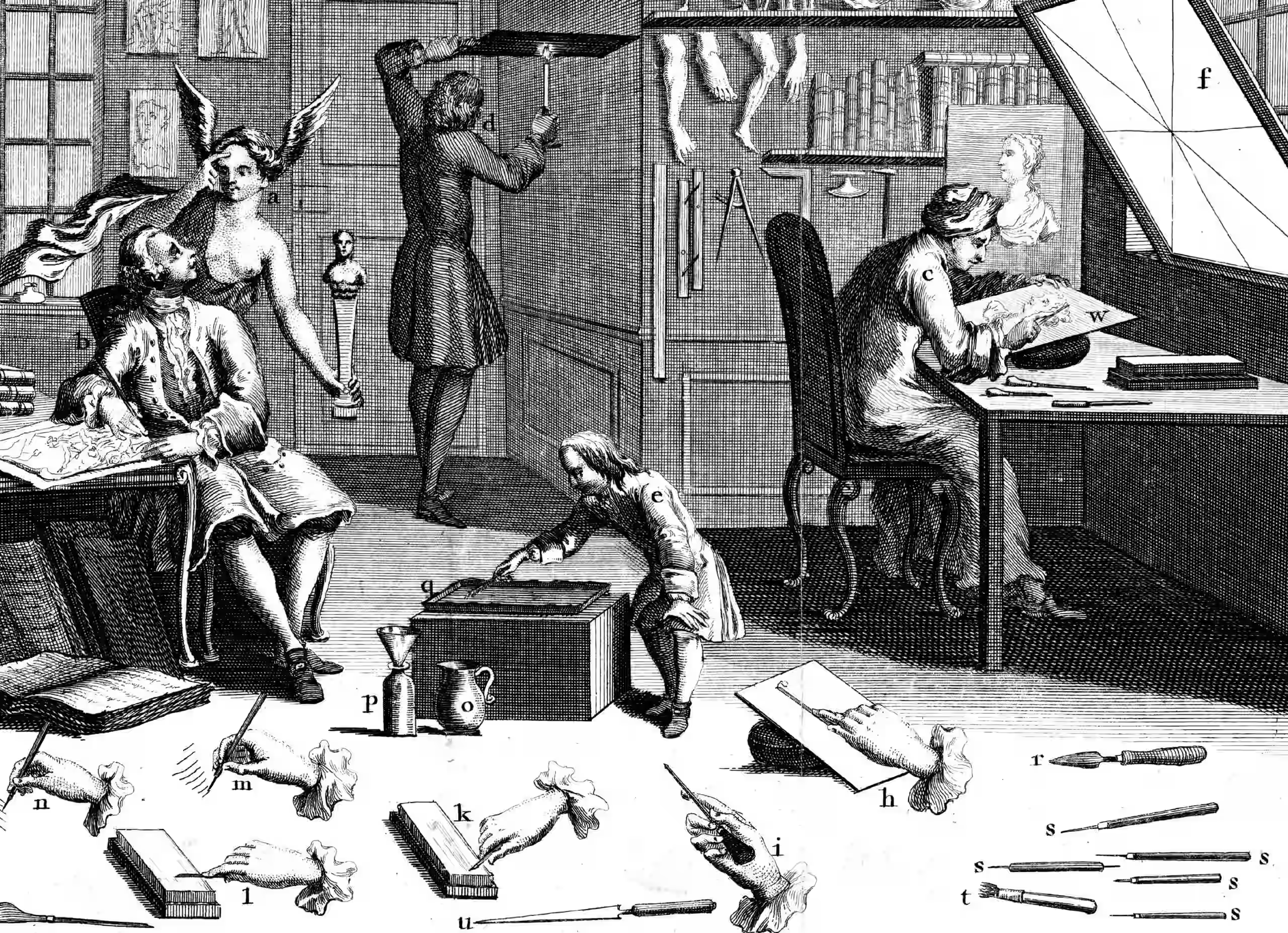
I don’t know much about art, but I can tell you what I like. Or show you, in this collection of my own bookmarks.
Basically, I got hooked on engravings during my public domain images bender and now I cannot stop.
Here are some artists that I <3.
1 Old master engravers
Martin Schongauer was good enough that a teenage Michelangelo copied his demon-swarmed St Anthony.
Albrecht Dürer, who drew the most famous rhinoceros in Europe without ever meeting one — armour-plated, riveted, sporting a spare horn. He also painted himself face-on as Christ, which took some cheek in 1500.
Pieter Bruegel the Elder, “Peasant Bruegel”, whose first hit print went out under the long-dead Hieronymus Bosch’s name because Bosch sold better — and who, legend has it, crashed village weddings in disguise to study the guests.
Cornelis Cort, who lodged in Titian’s own house to render the master’s colour as black-ink line and signed himself Cornelio Fiammingo.
Hendrick Goltzius, who fell into the fire as a child and engraved ever after with a clawed right hand — the very deformity, the story goes, that gave his burin its sweeping swing. He forged old-master prints so well his fake Dürers fooled the connoisseurs.
Adriaen Collaert, who married into the Galle printing dynasty and more or less invented the natural-history print series — his vivae icones (“images from life”) of birds, fish and flowers, the birds posed in proper landscapes rather than pinned to the page.
2 Satire and caricature
William Hogarth — moral box-sets like A Rake’s Progress that march their hero from inheritance to the madhouse — and so plagued by print pirates that he got Parliament to pass a copyright act named after him. He kept a pug named Trump and painted the two of them together, pet as self-portrait.
James Gillray, the savage genius of the Napoleonic cartoon, who drew Bonaparte as such a tiny tantrum-throwing manikin that we half-believe the man was short to this day. He worked above his publisher’s print shop and, eyesight and mind failing, threw himself from its attic window.
Sir John Tenniel gave us the definitive Lewis Carroll White Rabbit while blind in one eye — a fencing bout with his own father did for it. He did far more work as a satirist for Punch.
3 Visions and the fantastical
Piranesi, an architect who built almost nothing and instead etched Rome into everyone’s imagination — plus the Carceri, his “imaginary prisons” of staircases and pulleys that climb forever and arrive nowhere. Escher hung Piranesi prints in his studio.
-
- archive.org, especially Un autre monde (Grandville and Delord 1844), a masterwork. For a background about this guy, try the essay Grandville, Visions, and Dreams
More Jean Ignace Isidore Gérard Grandville! I am obsessed. And more: Jérôme Paturot à la recherche d’une position sociale
Gustave Doré, who illustrated what feels like every book that mattered — Dante, the Bible, Don Quixote, Paradise Lost — at industrial scale, a workshop of forty block-cutters chasing his pencil.
W. Heath Robinson, whose name became the British term for a teetering, over-engineered contraption held together with string and optimism (the Americans say “Rube Goldberg”).
John R. Neill, “Imperial Illustrator of Oz”, who drew some forty Oz books after taking the franchise over from Denslow and gave Baum’s gingerbread man his face in John Dough and the Cherub (Baum and Neill 1906).
4 Wyrd science & engineering
Robert Fludd supposedly collaborated with Matthäus Merian the Elder on his engravings (Frietsch 2022).
Utriusque cosmi maioris scilicet et minoris metaphysica, physica atque technica historia (“The metaphysical, physical and technical history of both the greater and the lesser cosmos”) (Fludd 1617). See also Robert Fludd and His Images of The Divine.
Salomon de Caus, waterworks-wizard to the doomed “Winter King”, who filled Heidelberg’s gardens with musical fountains and mechanical singing birds. His Les raisons des forces mouuantes (Caus and Nugent 1615) sketches a steam-powered water-lifter — enough for later romantics to wrongly crown him inventor of the steam engine.
Athanasius Kircher was not an actual engraver, but his books are full of wonderful images, and his Musurgia Universalis is a particular favourite (Kircher 1650).
Thomas Wright and his An Original Theory or New Hypothesis of the Universe (1750) once again collaborated with nameless engravers to produce trippy armchair cosmology (Wright and Chapelle 1750).