Czechia
2026-04-18 — 2026-09-09
In Which the History of Czechia Is Surveyed Through Its Notable Exports, From Hussite War-Wagons and Defenestrated Diplomats to Pilsner Lager and the Word Robot.
I am re-visiting Czechia. I would like to write something worthy of the country, in the form of a slapdash, idiosyncratic, mildly contrarian take on a place I know poorly, while avoiding the hubris of thinking I can craft a gleech-tier take. I cannot afford to set my standard for quality that high any more than I can set my standards for time-management so low.
So! A slapdash, idiosyncratic, mildly contrarian one for you.
1 People and things from Czechia I knew before
Experimental condition: I primed myself before I arrived, writing down everyone and everything I have heard of that is Czech.
At time of writing I wonder: What will I miss? Which prejudices will I be demonstrating thereby? I am greatly curious.
I am attempting to triangulate the country from its more famous children.
Read down below this section for a post-arrival addendum of whom I missed.
1.1 Jan Hus
Religious reformer, fifteenth century. The Hussites are history heroes of mine, in that special way that long-dead people can be, where everything they did right was awesome and everything they did wrong was excusable, them being of their time. Jan Hus got the project of redoing Christianity decades before Luther; was rewarded for it by being duplicitously burned at the stake at Constance in 1415. The Hussite Wars that followed managed the impressive feat of inventing a folk-Protestant peasant army that beat back several Holy Roman crusades using armoured war-wagons and early handguns. The Protestant Reformation, and some kind of peasant uprising, ahead of its time, was a Czech thing. If they had waited for the printing press as well as handguns, history might have been different.
Also, Hus is often credited with inventing modern Czech orthography.
1.2 Karel IV
The Holy Roman Emperor we Anglophones call Charles IV. Made Prague the imperial capital in the fourteenth century, commissioned various things that make towns serious: the bridge, the cathedral, founded the university (1348) that still bears his name. For who came before and after, see the HRE timeline below.
1.3 Charles University / Univerzita Karlova
Founded by Karel IV in 1348 as the first university in central Europe, and possessed of a bonkers institutional biography ever since. I confess I did actually look this biography up when I was applying to work there, but that was in 2025, so I’ll put it on this page as received knowledge.
Originally the four student “nations” (Bohemian, Bavarian, Saxon, Polish) each had one vote in university affairs. In 1409 Wenceslaus IV decreed that the Bohemian nation should have three votes and the rest one between them; the German masters and students promptly walked out and founded the University of Leipzig, which is also still going. Jan Hus had been rector shortly before he was burned in 1415, after which the Hussites took over and the theology faculty was effectively closed for the next two centuries.
After the Habsburgs won the Battle of White Mountain in 1620, the Jesuits were handed the keys; in 1654 they merged the Carolinum with the Jesuit Clementinum to form the Charles-Ferdinand University, and the place was Catholicised by force.
In 1882 the institution was split into a Czech-language university and a German-language university, both called Charles-Ferdinand, sharing some libraries but not apparently much else. In 1939 the Nazis closed the Czech university and sent over a thousand of its students to concentration camps; in 1945 the German half was abolished in turn. The Communists purged the survivors in 1948. The students of Charles University were on the front line of 1989.
Language/religion of instruction across seven hundred years runs, more or less: Latin, Latin (Hussite), Latin (Jesuit), German, Czech-and-German-in-parallel, Reich-German, Czech. The medieval-university brand has not been done many favours, but it has survived.
1.4 Various Wenceslases
Mostly as an English speaker I know Wenceslaus I, Duke of Bohemia (907–935): the “Good King” of the Christmas carol, who was strictly a duke not a king (I confess I did need to look that up) and who was knifed by his brother. Thereafter there was a confusing line-up of Kings Wenceslas (II to IV I guess). The fourth one was Charles IV’s son and an aspirational Holy Roman Emperor (every family has one, amirite). The largest square in Prague is named for the first-mentioned, who became the patron saint of Bohemia.
1.5 Defenestration
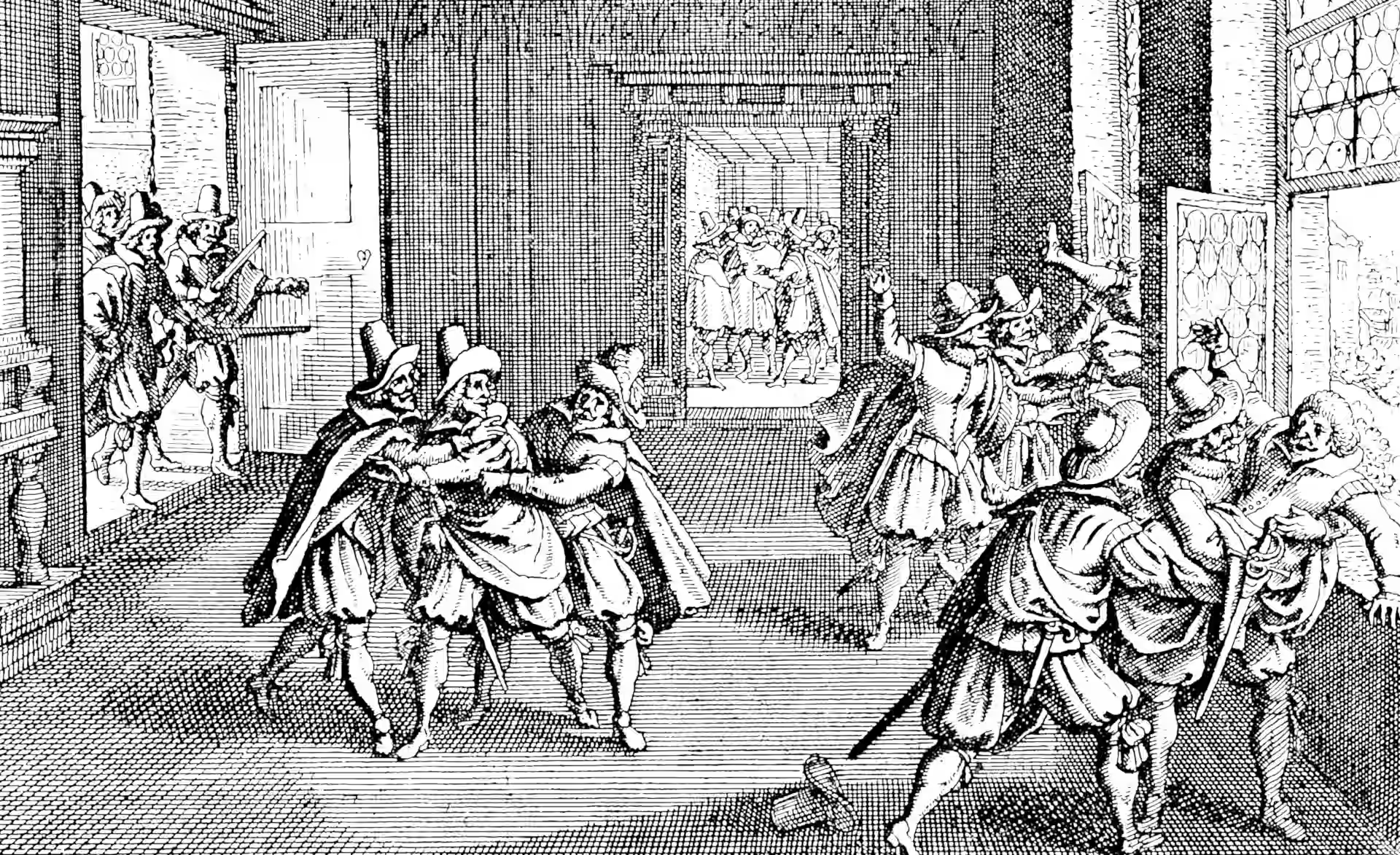
Throwing political opponents out of windows is a signature Czech contribution to constitutional procedure. The First Defenestration of Prague (1419) launched the Hussite Wars; the Second Defenestration (1618) launched the Thirty Years’ War. A non-canonical mini-defenestration occurred in between. The foreign minister Jan Masaryk fell out of a window in 1948 in a manner that was officially suicide and unofficially a third-to-fourth defenestration. I for one think it speaks to an architecturally progressive streak, that there was such a ready supply of tall buildings to throw people from at a time when the typical peasant didn’t have a floor.
1.6 Sudetenland
The German-speaking border regions of Bohemia, Moravia, and Czech Silesia. Most Anglophones (me included) know the word from WWII history class as the bit Hitler announced in 1938 he would invade in order to “protect” the Germans living there, which Britain and France then let him have at Munich, after which he promptly invaded everything anyway.
1.7 Milan Kundera
Novelist. The Unbearable Lightness of Being is the famous one that I am vaguely annoyed how much I like. Kundera defected to France in the 1970s, was stripped of citizenship by the Communist government, declined to come back after 1989, eventually wrote in French, fell out with the Czech literary scene, and got accused of having informed on a fellow citizen as a young man in 1950.
1.8 Václav Havel
Playwright, dissident, jailed, then president — first of Czechoslovakia, then of the new Czech Republic after the country split with Slovakia in 1993 (the “Velvet Divorce”). The model intellectual-as-statesman that the post-Soviet Eastern European liberal moment offered up. What happened to that moment?
Anyway, you can find Havel plays being performed in Prague right this very minute. How many presidential plays have you watched?
1.9 Viktor Koženy
The Pirate of Prague. Made off with several hundred million dollars of Czech voucher-privatisation money in the 1990s, had disastrous adventures in Colorado and Azerbaijan, fled to the Bahamas, and has since been wanted in several jurisdictions for variations of fraud.
1.10 Václav Smil
Polymath of energy, materials, agriculture. Czech-born Canadian academic. Bill Gates says he reads everything Smil writes; given the volume of Smil’s output this suggests that his books have cost the world a hundred million dollars in lost Gates time. I have complicated feelings about Smil, whose books were a major part of my undergraduate studies. I recall I did not feel that he really nailed the human dimension of energy transition. Enough time has passed that I cannot recall specific complaints, though.
1.11 Franz Kafka
A German-speaking Jewish insurance clerk in Prague who happened also to be the writer who tells us how it feels to live inside a bureaucratic empire. Published almost nothing in his lifetime, and demanded that it all be burned.
Is The Great Wall of China (de) hopeless orientalism or genius? Both.
Also, it was inspired by a wall in Prague.
1.12 Jan Švankmajer
Surrealist animator. The 1988 Alice (Něco z Alenky) gives me intrusive thoughts years afterwards: tactile, dreadful, made of dust and meat. I still send people animated GIFs grabbed from this nightmare.
1.13 Karel Zeman
“The Czech Méliès” — live-action and animation hybrid films, particularly the Jules Verne adaptations. They are, like, really good. Annoying they are only on DVD.
1.14 Antonín Dvořák
Composer, nineteenth century. We played New World Symphony (1893) in my family home to feel classy when I was a child. He wrote other music, but I do not know what, so I looked him up. I learned he spent three years running the National Conservatory of Music in New York, during which he told the Americans they should build a national music on Black spirituals and Native American melodies; this was unwelcome advice that the country eventually took.
1.15 Karel Čapek and Robots
Playwright and journalist. His play R.U.R. (1920) introduced the word robot to the world, and War with the Newts (1936) is on my to-read list as one of the better satires-with-amphibians ever written.1
1.16 Pilsner
The pale lager style invented in Plzeň in 1842, when a Bavarian brewer named Josef Groll got the local brewery to combine bottom-fermenting yeast, pale Moravian malt, and the local soft water. The result was a beer so popular it took over the world: every lager in a green or clear bottle anywhere is a descendant. Pilsner Urquell still exists; opinions on whether it has held up vary. I do not drink though, so I do not care either way.
1.17 Amanita design
Amanita design: The studio behind the Machinarium and Samorost series of point-and-click puzzle adventure games with achingly lovely and/or upsetting hand-made art. Relatedly, employee Floex is a musician I rather enjoy.
1.18 YUKU
YUKU: Cult hipster record label.
1.19 Mendel’s pea garden
Gregor Mendel, an Augustinian friar at the abbey in Brno, spent the 1850s and 1860s growing tens of thousands of pea plants and counting their offspring’s traits. He published a paper that was ignored for thirty years and then, around 1900, became the foundation of genetics. The mathematics of inheritance was figured out, more or less correctly, in a monastery vegetable patch. Except it was fabricated (Fisher 1936)! Or was it? (Ellis et al. 2019)
1.20 JetBrains
Developer-tools company originally headquartered in Prague since 2000. Makes IntelliJ IDEA, PyCharm, WebStorm, and the rest of the IDE bestiary; created Kotlin, which Google eventually decided was the right way to write Android apps. I just looked them up and they are now domiciled in the Netherlands; not sure if this still counts.
1.21 Atheism
Depending on how you count it, Czechia is the least religious country in Europe cf OurWorldInData. We can tweak our criteria and find that Estonia is less religious, depending on what kind of irreligiosity race we are running. Definitely up in the godless major leagues, either way.
2 People and things from Czechia I missed
2.1 Czechia is basically an ethnostate
What WWII history class about Sudetenland did not tell me is what happened after the war: in 1945–1946 Czechoslovakia expelled around three million ethnic Germans from these regions under the Beneš decrees, in one of the larger forced population transfers in European history.
The Sudetenland was depopulated, partially resettled by Czechs and Slovaks, and the German-Bohemian and German-Moravian cultures, in place since the medieval Ostsiedlung, just… ended?
The upshot is that Czechia is remarkably ethnically homogenous; 89% of the country report being Czech. The next largest ethnic group (Moravians) are rebranded Czechs (or if they aren’t they should edit their Wikipedia page to say so). The borders of Czechia are basically the borders of the Czech-speaking people. I’m not used to this, as a child of a nation of very patchwork origins.
WELL! The post-war Polish displacement into Recovered Territories was even bigger than the purging of Sudetenland. Not that this is a competition, now folks, don’t start trying to climb that leaderboard.
On that mass-slavic displacement point though, HT Jan Kulveit for this post-Russian-Ukraine-invasion update: There were 600K foreign residents in Czechia; but now many, many Ukrainians. I have heard numbers like 500K? I didn’t notice them because they don’t show up on the 5-yearly census.
2.2 Experiential learning
Zážitková pedagogika and the other heirs of Prázdninová škola Lipnice (“Vacation school Lipnice”) (Holec 2022; Jirásek and Turčová 2020; Kudláček et al. 2009).
tl;dr; There is totally a local school of weird experimental learning (swimming across lakes with a fire, spending hours blindfolded) which originates in the communist era and still seems to be a local specialty.
The way Czech folks flippantly talk about “that time I was hilariously black-bagged and tied up” for pedagogy was startling the first time I heard it, but now I am somewhat inured.
But also, wtf?
(HT Ondřej Bajgar and Anička Doležalová).
2.3 Jára Cimrman
In 2005, Jára Cimrman won a public vote for the title of “The Greatest Czech” (he was subsequently disqualified due to being a fictional character).
2.4 Tycho Brahe
Tycho Brahe: A Danish nobleman and astronomer whose observations of the heavens provided the basis for Kepler’s laws of planetary motion. Emperor Rudolf II appointed him imperial mathematician in Prague in 1601, and he died there. (HT Jan Kulveit.)
2.5 Oh damn Johannes Kepler too
Johannes Kepler, the guy who inspired Newton to do the gravity thing, spent 12 years of his career in Prague. I did not know that.
2.6 Rabbi Judah Loew ben Bezalel and the Golem
Rabbi Judah Loew ben Bezalel: The Rabbi of Prague, often associated with the creation of the Golem, a mythical creature made from clay and an early metaphor for a loss of control in AI. The good Rabbi was a real person who actually died here. It’s embarrassing that I didn’t know about this. (HT Jan Kulveit.)
2.7 Mikuláš of Kadaň, Jan Šindel and Prague’s Astronomical Clock
That famous clock also has a twisted history. (HT Jan Kulveit.)
2.8 Jan Patočka
Jan Patočka was a philosopher, dissident, and Charter 77 signatory who died in police custody in 1977, and whose library I am currently working from. (HT Jan Kulveit.)
2.9 Jena Codex
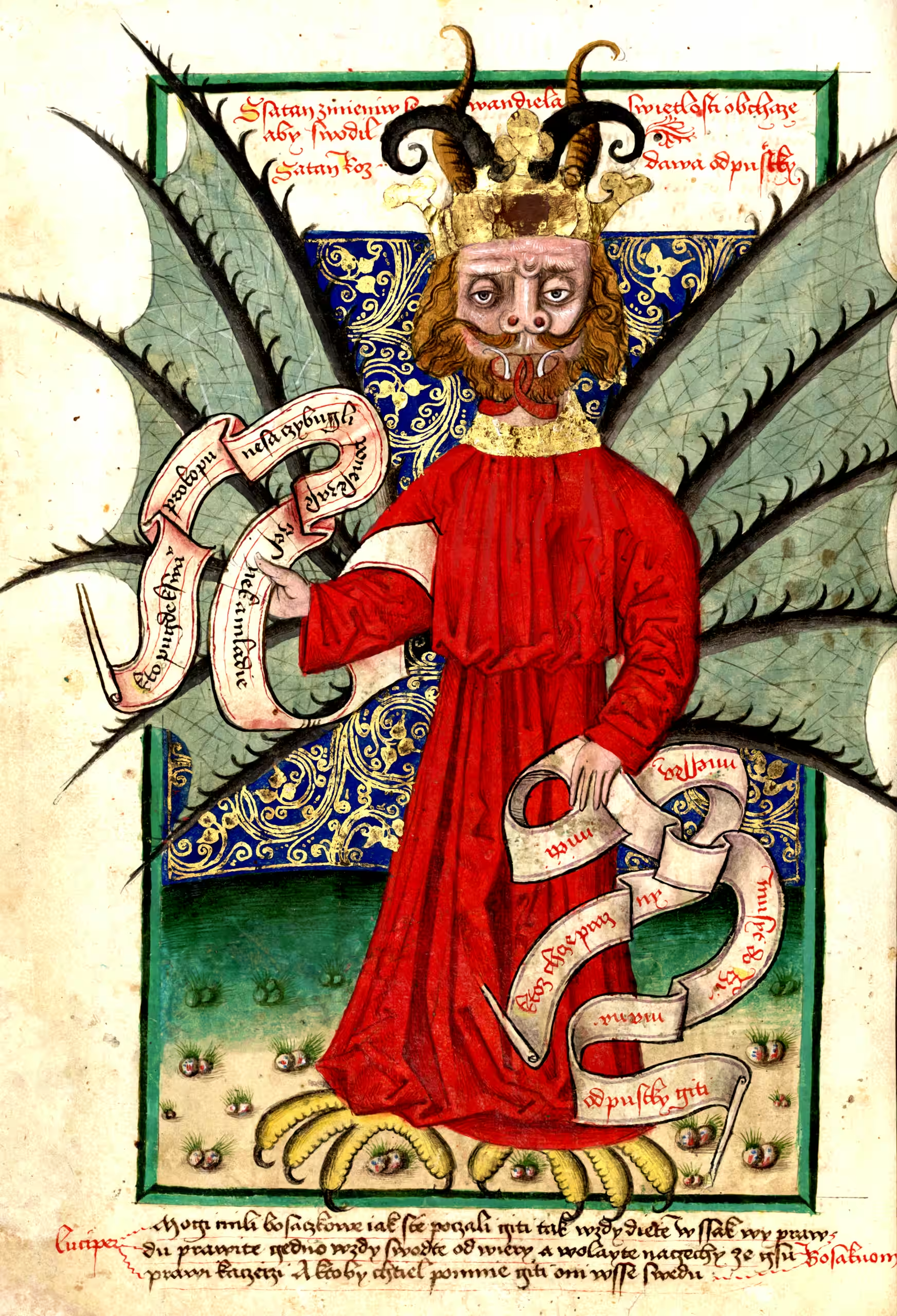
The Jena Codex, also called the Jenský kodex or Antithesis Christi et Antichristi, is badass Figure 2. It is, I am told by Czech Wikipedia, an illuminated Hussite manuscript from around 1500, commissioned by the Utraquist (i.e., Hussite-flavoured) Bohuslav of Čechtice. I cannot read it, but apparently it is full of theological and polemical texts contrasting the early Christian Church with the Church of Jan Hus’s time. Here are three online versions of it:
2.10 Jan Žižka
If I think the Hussites are so impressive, I should probably have credited Jan Žižka, the general who led the radical, peasant-filled Hussite armies in the wars that followed Jan Hus’s death — while blind.
2.11 Coffee
Prague coffee is, remarkably, reliably good. Why is this?
2.12 Other musicians of note
3 When was Prague the capital of the Holy Roman Empire?
Turns out that by a sufficiently loose definition, five rulers of the Holy Roman Empire had their court in Prague between 1346 and 1612.
| When | Who | Notes |
|---|---|---|
| 1346–1378 | Charles IV / Karel IV | The textbook dude. Made Prague the imperial seat, built the bridge, the cathedral, the university. |
| 1378–1419 | Wenceslaus IV / Václav IV | Charles IV’s son. King of the Romans 1376–1400, deposed; never crowned Emperor. Reorganized Charles University in 1409. Tried to protect Jan Hus. |
| 1436–1437 | Sigismund of Luxembourg | HRE 1433–1437, brother of Wenceslaus IV. The Sigismund who duplicitously had Jan Hus burned at Constance in 1415. The Hussite Wars (1419–1436) were in part a war against him. The Bohemians would not have this guy as king and so he was based in Buda for all but the last year of his reign. |
| 1583–1611 | Rudolf II | Habsburg. Moved the imperial court Vienna → Prague in 1583 and kept it there about thirty years. Patron of Tycho Brahe, Kepler, assorted alchemists. |
| 1611–1612 | Matthias | Inherited Rudolf’s Prague court and moved it back to Vienna within a year at his wife Anna of Tyrol’s urging. Ended Prague-as-imperial-capital. (booo!) |
Six years after Matthias left, the Second Defenestration of Prague (1618) launched the Thirty Years’ War. The Habsburgs ultimately won in 1620 and Catholicized Bohemia by force, grinding out at least the religious dimension of Czech national identity for the next three centuries. Czech politics (at least as national politics) then went into hibernation until 1918.
4 Language
4.1 Survival kit
- Hello
- Dobrý den [ˈdobriː ˈdɛn] (roughly “DOB-ree den”; literally “good day”). Informal: Ahoj [ˈaɦoj], like sailors.
- Thank you
- Děkuji [ˈɟɛkujɪ] (roughly “DYEH-koo-yee”). Casual short form Díky [ˈɟiːkɪ].
- Please
- Prosím [ˈprosiːm]. The same word does multiple duty for “you’re welcome”, “pardon?”, “here you are”, and “after you.”
- Excuse me / sorry
- Promiňte [ˈpromiɲtɛ] (formal). Pardon [ˈpardon] (yes, the French loan) is widely understood.
- Goodbye
- Na shledanou [na ˈsxlɛdanou̯] formally; Ahoj [ˈaɦoj] or Čau [ˈt͡ʃau̯] (like Italian ciao) informally.
- Do you speak English?
- Mluvíte anglicky? [ˈmluviːtɛ ˈaŋɡlit͡ski] (roughly “MLOO-vee-teh AHN-glits-ki”). The verb takes the adverbial form anglicky, in the same shape as mluvím česky, “I speak Czech-ly”. Cool.
- Sorry, I am an idiot foreigner who only speaks English
- Promiňte, jsem hloupý cizinec a mluvím jenom anglicky [ˈpromiɲtɛ jsɛm ˈɦloupiː ˈt͡sizinɛt͡s a ˈmluviːm ˈjɛnom ˈaŋɡlit͡ski] (roughly “PRO-min-teh, ysem HLOH-pee TSEE-zee-nets ah MLOO-veem YEH-nom AHN-glits-ki”). Hloupá cizinka for the female form, apparently. The terser retreat Promiňte, neumím česky, “Sorry, I don’t know Czech”, may also serve but that is not as funny. NB this is an AI-generated translation; how did we do, Czech speakers?
- Yes
- Ano [ˈano] (“AH-no”). Casually shortened to jo [jo], which is German ja in Czech orthography. Confusingly to English ears, the Czech word no is also a colloquial agreement particle (“well, yeah”).
- No
- Ne [nɛ] (“neh”). Repeat for emphasis: Ne, ne, ne.
And of course, I love flashcards. Here are some:
- 🇨🇿 The Ultimate Czech Deck – Languages on Fire (A1 to B1) - AnkiWeb
- Czech Core 100 - Basic words (EN CS with audio) - AnkiWeb The author really wants you to know dates, days of the week etc before you learn how to say “Promiňte” and “Prosím”. I wonder what the creator’s project was in Czechia? Very heavy on calendars, whatever it was. Anyway they have pronunciation audio for everything, so I still recommend it even for people who do not want to start their Czech learning journey with “Tuesday the 12th of September”.
4.2 Václav and Wenceslaus
Secretly the same. In modern English we use Václav for contemporary Czechs (Havel, Smil, Klaus) and reserve Wenceslaus (the Latin form) or Wenceslas (the slimmed-down English version) for medieval rulers — Wenceslaus I Duke of Bohemia, Wenceslaus IV who issued the 1409 reorganization of Charles University, and so on.
AFAICT this distinction is not drawn in Czechia. Václav descends from an old Slavic Vęceslavъ, “greater glory”, which Latin took up as Wenceslaus; English kept the Latin form for kings even after dropping it for everyone else.
4.3 Prague and Praha
The city is Praha in Czech. English took the form Prague via Latin Praga and French. The same pattern by which Anglophones say Vienna, Munich, Warsaw, Cologne, Geneva instead of Wien, München, Warszawa, Köln, Genève.
4.4 “Bohemians”
Czechia used to more-or-less be called Bohemia by non-Czechs. It seems that the word was always an exonym. IIRC the reason that bohemian now means “artistic nonconformists” in English is not because the Czechs were especially artistic or nonconformist, but that the word was borrowed from French in the nineteenth century, and the French called Romani bohémiens as a kind of geographic origin story for the Romani and romanticized their lifestyle as carefree and creative-looking. There are not especially many Romani people in Czechia now, but maybe this made more sense before the war and communist repression etc.
4.5 “Czechs”
English has some fossilized spelling from before the 19th century. Czech = Čech (masc) or Češka (fem) in Czech. The language is čeština, the adjective is český, and the country is Česko. But I am sticking with Czechia, since it is the official English name.
5 Is Czechia in Central Europe or Eastern Europe?
I vote Central.
Reasoning:
- It was in the Holy Roman Empire, the most central European institution there ever was
- OK, it was in the Soviet bloc, but as a vassal state like Poland and Hungary were, not like Russia was
- Speaks a Slavic language, which tends to code easternness (but then cf Romania, which speaks a non-Slavic language and is coded way more eastern). Also, their script has been Latin since the Middle Ages.
- More geographically west and less religiously Orthodox than Greece, which is not eastern because they invented democracy and philosophy and stuff and the Mediterranean gets you a pass for some reason?
- Godless, which is to say, has not joined the eastern trend to re-embrace religion as a marker of identity post-communism
- Successfully invaded by Hitler in 1938, but not successfully invaded by Stalin in 1948 (unlike Hungary and Poland)
- They sauna naked (unlike the Russians, but like the Scandinavians)
- Invented the Protestant Reformation 80 years before Luther and fought a war about it. What could be more central European than a war of protestant peasants against an oppressive church?
- To paraphrase my Romanian colleague Teodora, “pfft you call this eastern? you should see Romania.”
Conclusion: No more eastern than Slovenia, and more central than Hungary and Poland. Therefore: Central.
Now, a more interesting case is former partner state Slovakia. Are they central or eastern Europe? This question is left as an exercise for the reader.
6 Prague
OK, it is actually pretty. Decayed imperial grandeur, baroque churches, gothic cathedrals, Art Nouveau facades, and a river running through it. Overlaid w/ soviet utilitarianism, low-budget 90s lowest-bidder capitalist renovation. Not quite as pretty as Venice, say, but way more lived-in and less museum-y.
By which I mean, it is less museum-like. It is probably more museum-dense. Wow, so many museums! Some really fancy-sounding ones, and a long tail of very random stuff; Madame Tussaud’s franchise, chocolate shops with “chocolate museums” attached to them, and some really suspect Ripley-axis stuff, e.g. “Museum of Sex Machines”.
More tourists than I was expecting, but like, even in the old town, also some normal humans doing non-tourist lives in between the tourists. The mix of tourists, Habsburg cosplayers and philosophy students on their way to band practice seems fine?
6.1 Bikes
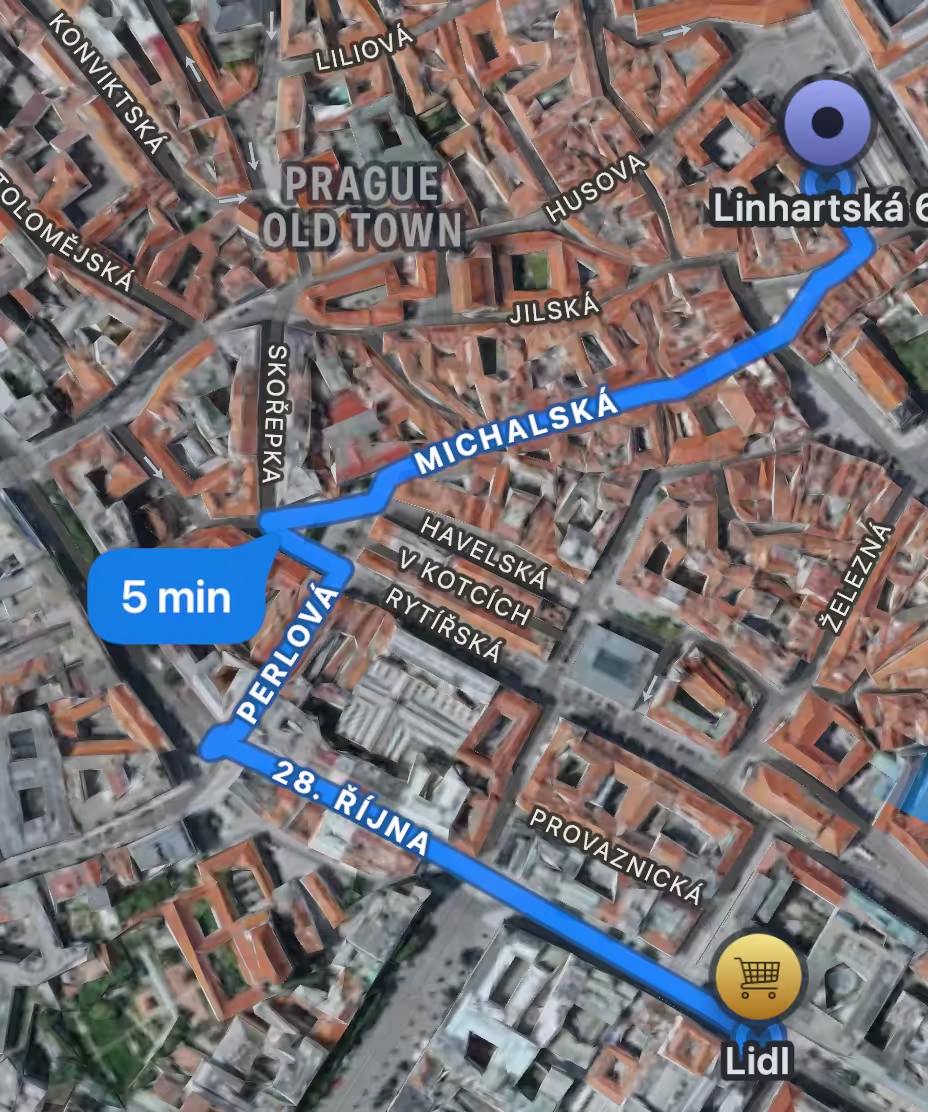
Prague’s bike infrastructure in the old town is meh, but it gets better in the more modern bits. “Similar to Sydney but with more cobblestones” is my review. Also the riding directions are aggressively bad on Apple Maps, like “Please ignore the bitumen road and take this much longer detour via some cobbled pedestrian walking street which is both more crowded and more difficult to ride on” Figure 3.
To be fair, Apple Maps generally sucks here. Google Maps Mapy.cz is the main game.
6.2 Workout stations
- Fitness Park RVL13 – Riegrovy Sady. Inside the popular Riegrovy Sady park in Vinohrady (Prague 2). Full calisthenics setup with gym foam flooring, good shade, and a public toilet 12 metres away. I’ve been using this one.
- Workout Hřiště u FK Viktoria Žižkov — Prague 3, right next to a tram stop making it very easy to reach. Covers all muscle groups, good surface for ground-level exercises too.
- Venkovní Posilovna Vinohrady — Prague 10, solid pull-up and dip bar setup.
- Workout Place – V Olšinách — Quieter spot in Prague 10 in a park setting.
- Street Workout Hřiště Prosek — Prague 9, pull-up bars, parallel bars, abs benches.
6.3 Saunas
TBD. I had better return and find out.
6.4 Suicide bridge
Nusle Bridge famed for suicides and being stress-tested by tanks.
7 Postage
Everything seems to require parcel lockers. Parcel lockers are annoyingly parochial and require HU/CZ/RO phone numbers to use.
8 Incoming
🚧TODO🚧 get corrected on all of the above by someone who lives there.
- A local friend’s doc about this: Prague visit card - Couchsurfing
9 References
Footnotes
A short list, admittedly.↩︎