Decision theory in mechanized causal graphs
Newcomb’s box via the back door, the intentional stance for arrow diagrams
2026-05-05 — 2026-05-06
Wherein Mechanism Nodes Are Introduced as First-Class Elements of Causal Graphs, and Newcomb’s Problem Is Examined Such That a Predictor Is Seen to Read an Agent’s Policy Rather Than Its Act.
Causality, agency, decisions, learning is the motivation for this notebook. There we hand-waved through mechanized causal graphs.
Here I intend to go deep into the formalism introduced in Everitt et al. (2021) and Everitt et al. (2022). I have not done so yet to my satisfaction — this is a WIP.
The point of the notation, compared to classical DAGs, is that mechanism nodes are first-class, so we can talk about edges between mechanisms — e.g. an agent reasoning about how its objective depends on the world’s mechanism, or a predictor reading the agent’s policy.
By the end of the notebook I hope to be able to use MacDermott, Everitt, and Belardinelli (2023) to illuminate cosmic decision theories, and think about agency under bounded compute in a more mechanistic way.
In much the same way that I think standard DAGs have a role in uncovering some hidden assumptions in ML, I think there are some hidden assumptions in cosmic decision theories that mechanized causal graphs will help us uncover. Eventually. Let us see.
Later, we may even be able to use Kenton et al. (2023) or MacDermott et al. (2024) to discover intentionality in the world.
1 Mechanizing causal graphs
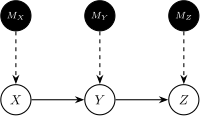
A mechanized causal graph augments a causal DAG with a mechanism variable (also called a policy) for some object-level nodes — encoding how that node’s value is generated from its parents by some kind of learned (“agenty”) mechanism (Kenton et al. 2023).
Layered on top is the influence-diagram convention from (Everitt et al. 2021): rectangles for decisions, diamonds for utilities, ovals/circles for everything else.
What are we doing when we claim that some nodes are special “mechanism” nodes? AFAICT formalising the intentional stance.
LaTeX tutorial (actually a TiKz tutorial.)
| Symbol | Style | Meaning |
|---|---|---|
| ◯ | obj |
object-level chance variable |
| ● | mech |
mechanism variable |
| ▭ | dec |
decision |
| ◇ | util |
utility |
→ solid |
causal |
causal edge between object-level variables, or functional edge from mechanism to its variable |
→ dashed |
mech-edge |
non-terminal mechanism dependency |
→ dashdotted |
objective |
terminal mechanism edge (an agent’s objective) |
2 Object-level DAG
The starting point — a vanilla causal DAG with no mechanism layer.

Each object variable acquires a mechanism node above it. Writing the edge from \(M_X\) to \(X\) dashed is notation rather than a new kind of relation. We imagine it represents a lifted structural equation : where the object-level SEM has \(X := f_X(\text{pa}(X), U_X)\), the mechanized version is \[X := \tilde f_X(M_X,\, \text{pa}(X),\, U_X),\] with \(M_X\) parameterising a function space and \(\text{eval}\) the universal “apply this function to these arguments” operator. Under this lifting \(M_X \to X\) is an ordinary causal edge — intervening on \(M_X\) (swapping the policy) has the standard interventional semantics
3 Cosmic decision theories
The mechanized view earns its keep on problems where the agent’s policy is itself an input to some other variable. In Newcomb’s problem the predictor \(P\) forecasts the agent’s decision \(D\) — but \(P\) is causally upstream of \(D\), so the dependence cannot be captured by an object-level edge from \(D\) to \(P\). The mechanized graph routes it through \(M_D\), the agent’s decision mechanism (its policy): \(P\) depends on \(M_D\), and \(M_D\) functionally determines \(D\). The dashdotted edge is the literature’s objective/terminal-mechanism edge style — used loosely here to flag the “back door” through which the predictor accesses the agent.
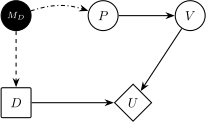
The intended reading: prediction \(P\) determines box contents \(V\); the agent’s mechanism \(M_D\) implements a policy that produces a decision \(D\); utility \(U\) depends on both the contents and the choice; and the “Newcomb-ness” lives in the dash-dotted edge \(M_D \to P\) — the predictor sees the policy, not the act.