Collaborative intelligence between humans and machines
Also human amplification
2021-09-12 — 2025-02-16
Wherein the Centaur Model of Human-Machine Teaming Is Surveyed Alongside Its Inversion, the Reverse-Centaur, in Which Humans Serve as Actuators for Algorithmic Systems Rather Than Directing Them.
🚧TODO🚧 Definition.
We want collaborative intelligence as a term to mean something about humans and machines working together to achieve goals more effectively than either could do alone. Ideally, each side contributes complementary strengths: humans bring domain knowledge, empathy, and contextual understanding, while machines offer speed, scalability, and pattern-finding. Easy to say…

1 History
🚧TODO🚧.
Highlights:
- Early mechanical aids: The abacus and mechanical calculators illustrate how humans have long offloaded certain tasks to machines.
- Man-Computer Symbiosis (1960): J. C. R. Licklider proposed a future where people and machines form cooperative interactions.
- Centaur Chess (1997): After Deep Blue defeated Garry Kasparov in chess, Kasparov introduced the notion of a “centaur”: a human teamed with a chess engine, often defeating either top humans or top engines alone.
- What next?
2 Human-in-the-loop learning
Human-in-the-loop systems integrate people at intuitively critical points:
- Data labelling & feedback: Humans supply correct labels to teach or correct AI models.
- Decision support: AI proposes actions; humans evaluate or override them when needed (as in medical imaging, content moderation).
- Iterative collaboration: Humans and models co-create solutions—for instance, generative AI for design, where the system proposes a design that humans refine.
🚧TODO🚧: Expand on success stories (e.g., medical diagnosis), the significance of RLHF (Reinforcement Learning from Human Feedback) in “aligning” AI systems with “human values”. Temper with mentions of pitfalls like algorithmic bias and automation complacency (where humans over-rely on AI and become less vigilant). Discuss how these factors can lead to real-world errors, ethical concerns, and missed opportunities. Connect to the social brain literature.
2.1 RLHF
Reinforcement Learning from Human Feedback (RLHF) marks one point in the landscape of human-AI collaboration. On one hand, it’s a way to tune AI to what we actually want—humans give feedback, and the AI learns to align with our preferences. On the other hand, if RLHF works “too well”, we might automate ourselves out of the loop entirely. Or, it might be easier to hack the human reward functions than it is to improve the AI.
3 Pedagogical centaurs
How well can AI partner with a human learner to assist the human’s own cognition? See AI tutoring — Mollick’s Machines of Mastery is a classic reference point.
4 Our robot regency
How long might it be worthwhile to augment humans instead of simply replacing them with fully autonomous systems? What does it look like when humans have nothing to add?. Some argue that complete automation is inevitable once AI systems outperform humans in economically relevant tasks; others contend that certain human qualities—empathy, accountability, or creative leaps—remain indispensable.
5 Reverse-centaurs
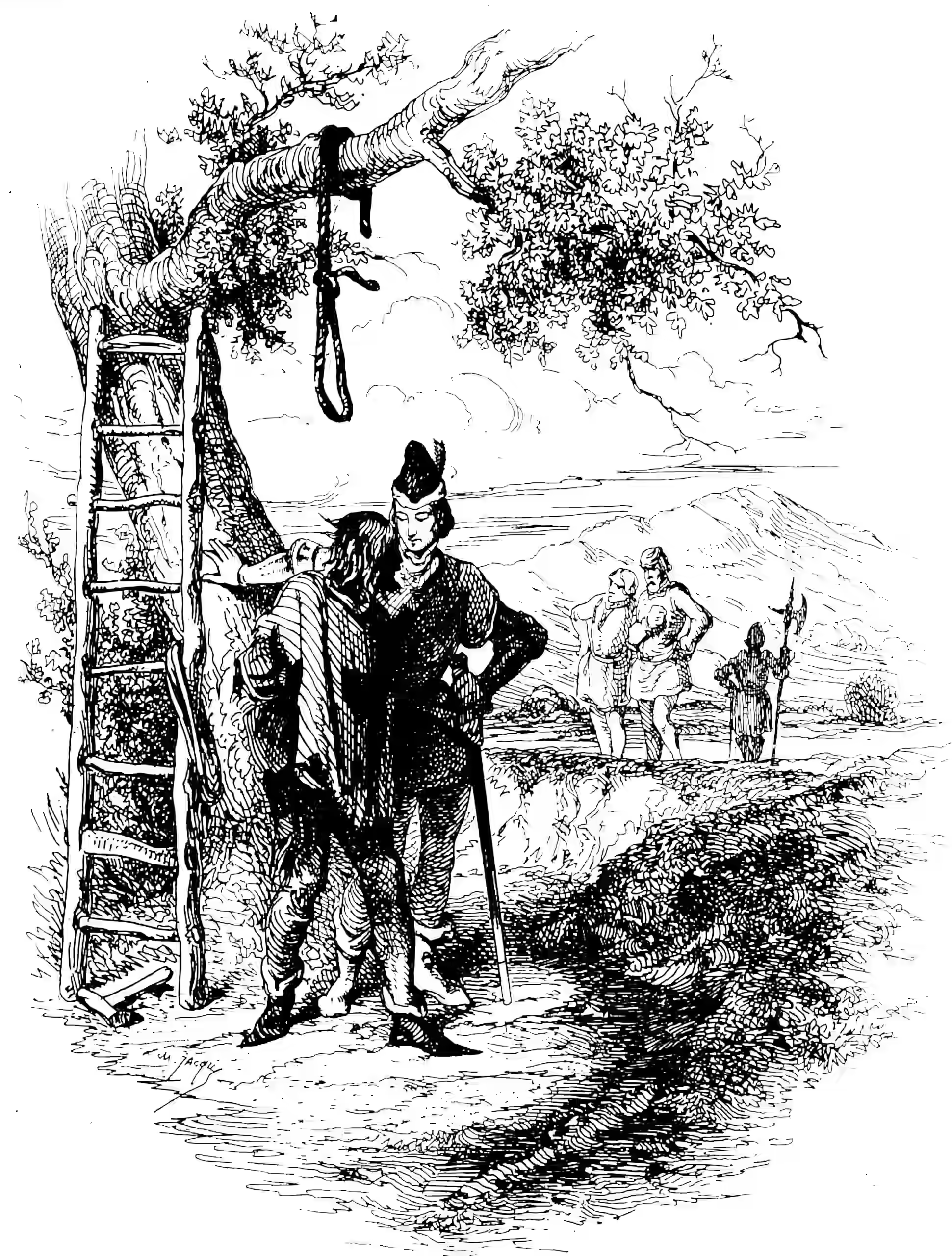
A reverse-centaur is the nightmare inversion of a centaur setup where the locus of control does not reside in the human partner. Instead of being enhanced by AI tools, humans end up being the fleshy actuators for menial tasks dictated by an “AI overlord” that calls the shots. Think of platform-based gig work, or scenarios in which humans feel more like cogs in a system. Notable works in this vein include a lot of Cory Doctorow shouting about things:
6 Remoras
Alternative model.
7 Incoming
Lauren Oakden-Rayner, No Doctor Required: Autonomy, Anomalies, and Magic Puddings
Are Model Explanations Useful in Practice? Rethinking How to Support Human-ML Interactions.
How to Make Tech Products (that Don’t Cause Depression and War)
Ethan Mollick, Centaurs and Cyborgs on the Jagged Frontier
Tackling Collaboration Challenges in the Development of ML-Enabled Systems
Susskind and Susskind (2018) (The Future of the Professions)
Norman (1991) (Cognitive Artifacts)
Krakauer, David. “Will A.I. Harm Us? Better to Ask How We’ll Reckon With Our Hybrid Nature”
Danaher, John. “Competitive Cognitive Artifacts and the Demise of Humanity: A Philosophical Analysis”
Job automation
- Workshop Labs is notionally building collaborative intelligence
- Mechanize.: unsourced scuttlebutt claims they started out looking at collaborative intelligence but have pivoted to aggressive replacement?