Peer review meets AI
Incentives for truth seeking at the micro scale and how they might be improved
2026-05-16 — 2026-10-09
Wherein the DOGE Protocol Is Introduced, Structured Rebuttals Are Mediated by Language Models, Arbitrator Findings Are Tethered to Confidence Scores, and Audit Trails Are Established for Human Meta-Reviewers.

What if our scientific peer review systems were already creaking under strain, and then someone introduced generative AI into the mix? That would be a wild ride.
The back-and-forth between authors and reviewers, especially during rebuttals, can be productive and helpful in principle, but it is inconsistent in practice. Meta-reviewers can struggle to adjudicate complex technical disputes quickly.
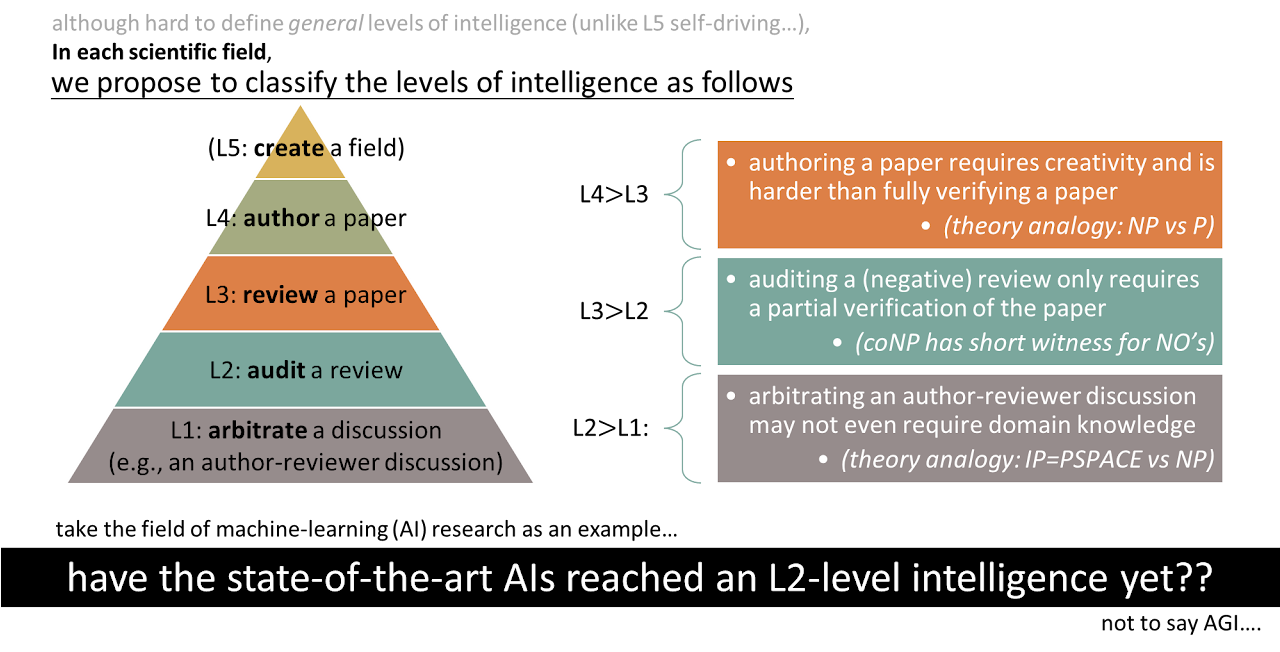
A recent proposal suggests adding a bounded-round arbitration step using AI adjudicators (Allen-Zhu and Xu 2025). The idea is that arbitration (analyzing an existing dispute) may be cognitively easier than full reviewing (generating a novel critique), and that today’s language models may already be competent enough (L1 or L2 competence) in some domains. See the CF debate protocols and other scalable-oversight-style alignment ideas.
In such a protocol, after authors submit a structured rebuttal to reviewer comments, an AI arbitrator (using a standardized prompt and fixed turns) evaluates specific contested points and issues a finding with a confidence score and citations to the text. Human meta-reviewers then consider this finding alongside the original human reviews. Key design features include bounded rounds of interaction, giving authors the last word (to offset the advantages reviewers get from anonymity), and logging all arbitrator chats for auditability (Allen-Zhu and Xu 2025).
Potential benefits include increased consistency, immediate logic checks, and a searchable audit trail. A neutral arbitrator may also lower the social costs (“face costs”), making it easier for reviewers and authors to admit errors. However, challenges include model variance, domain gaps (e.g., in mathematics-heavy areas), and the need for careful governance.
See also AI agents in science for more hands-on ideas about AI roles in parts of the research workflow other than review.
There are many variants on the theme of AI-assisted review, including AI-generated initial reviews, AI-summarized discussions, and AI-flagged statistical checks.
1 Incoming
Coordination Tech in Science: Letters, Journals, and Whatever Comes Next | shishyko!
SakanaAI/AI-Scientist: The AI Scientist: Towards Fully Automated Open-Ended Scientific Discovery 🧑🔬 / The AI Scientist: Towards Fully Automated Open-Ended Scientific Discovery (Lu et al. 2024)
They say this is about scientific research generation, but I think it’s also about peer review, as that ends up being part of their workflow.
The Black Spatula Project — Steve Newman
A 10 page paper caused a panic because of a math error. I was curious if AI would spot the error by just prompting: “carefully check the math in this paper” especially as the info is not in training data.
o1 gets it in a single shot. Should AI checks be standard in science?
Repository: nick-gibb/black-spatula-project: Verifying scientific papers using LLMs
Also, there are many articles on this(Couto et al. 2024; Kim, Lee, and Lee 2025; Kuznetsov et al. 2024; Liang et al. 2024; Liu and Shah 2023; Lu et al. 2024; Ye et al. 2024).