Human domestication
2025-01-18 — 2025-04-08
Wherein Humans Are Proposed to Be Domesticated Relative to Their Institutions, and a Mathematization Is Sketched in Which Individual Agency Is Assessed by Causal Influence Over Systems, With Traces of Operant Conditioning Considered.
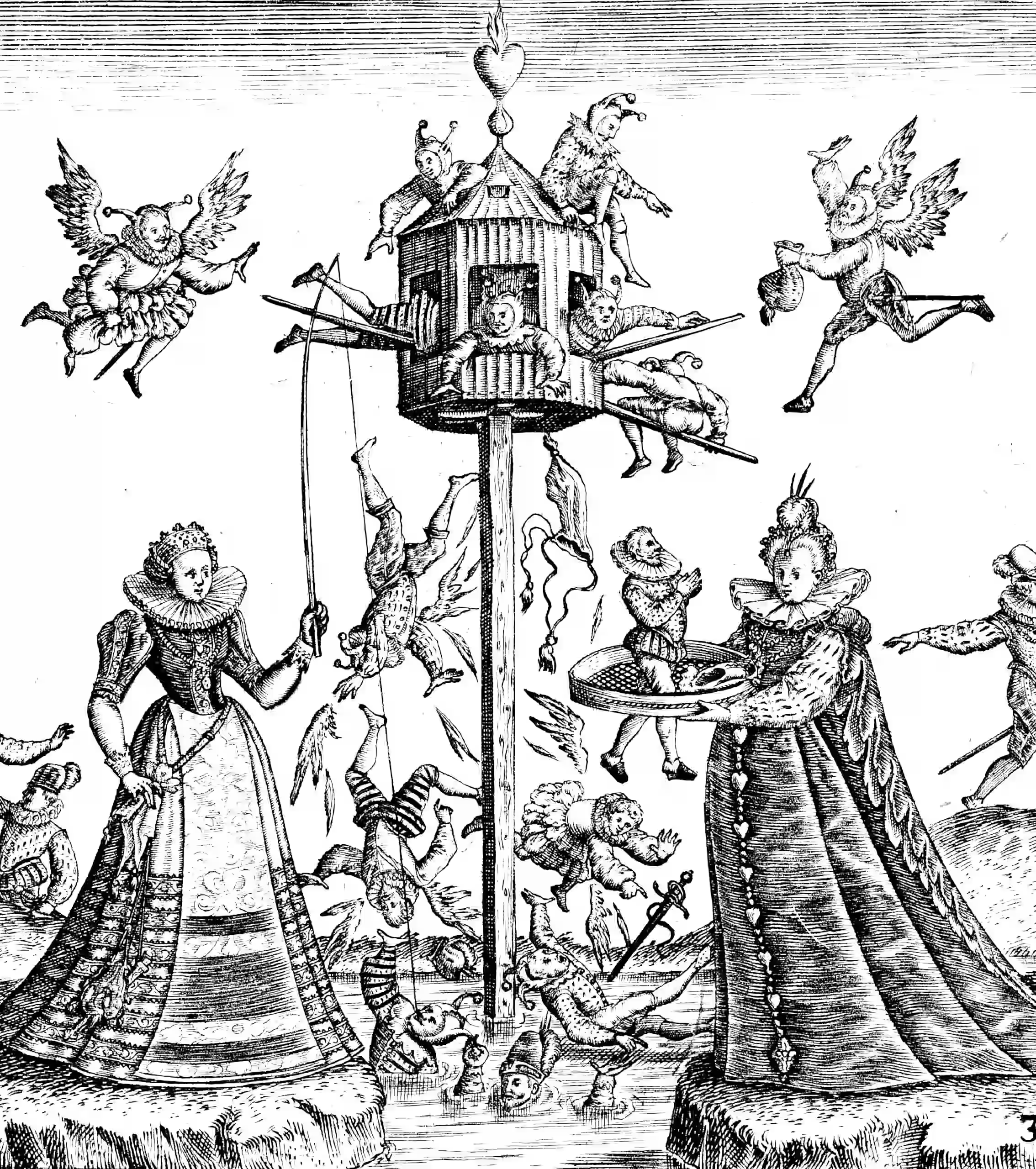
Notebook on the idea of human domestication. I’m not sure exactly what this means, but I think that cows are domesticated relative to farmers. Are we humans domesticated relative to our institutions? What does it mean to be domesticated?
Maybe when we have been thoroughly operant conditioned, we have been domesticated. Maybe when our environment is predictable and reproducible we are domesticated.
I am am not sure, but vibes incline me to keep thinking about this.
Possibly the opposite of being stroppy.
1 Mathematization
How much agency do I have in a given system? How do we work out who is the farmer, and who the cattle? There is one mathematization of that under causal agency where we try to identify players from NPCs by their ability to influence the world more than they are influenced by it, but I have doubts about whether this will work because it is still about closed systems with predetermineds states and I think that domestication might have something to do with open-endedness.
2 Incoming
Ted Xiao, Modern AI is Domestification is about models: “Modern AI is now the study of digital domestication: the art and science of taming wild internet-scale data distributions.”
Predation as Payment for Criticism | Compass Rose
A predator’s success depends on exploiting specific flaws in prey—poor awareness, slow reactions, weak social coordination. Unlike resource competition or disease, which select based on physiological robustness, predation creates focused pressure on intelligence, pressure which favours the development of consciousness. A cheetah doesn’t catch just any gazelle, but the one that fails to notice and react effectively. Prey get better at evading, predators get better at predicting, each side has to model the other’s thoughts more accurately—an arms race that eventually rewards both sides for explicitly modeling the other’s perspective, the basis for cognitive empathy. If you’re glad you’re conscious, no need to thank a predator—somebody else already did—by being eaten.
Life on the Grid (part 1) - by Roger’s Bacon
To review: growing up in simplistic spatial environments and using GPS has given you brain damage and life has become a soul-crushing video game utterly devoid of mystery or adventure. We are trapped in the Grid like an insect in the spider’s web; vigorous struggle will only serve to entangle us further. To extricate ourselves, we must, as individuals, gently subvert the very foundations of the Grid, which is nothing external but a facet of human nature: the impulse towards control, the systematising instinct, the part of us that abhors anomaly and ambiguity and seeks to eradicate them. What begins as an earnest attempt to break free can so easily slip back into a self-imposed system of rules and practices with standards to be met and schedules to be followed. For that reason I am hesitant to provide any concrete suggestions—they will only serve to constrain your thinking. For now, there is perhaps only one thing that can be said: if you want to get off the grid, then get lost.
Environmental enrichment, also known as behavioural enrichment, provides species-appropriate challenges, opportunities and stimulation. Environmental enrichment includes the regular provision of dynamic environments, cognitive challenges and social opportunities. An enriched environment should promote a range of normal behaviours that animals find rewarding as well as allowing animals to positively respond to potential stressors. For example, opportunities to hide or climb away from visitors or more dominant co-specifics.
Alfred Ng, Derek Robertson — When AI ‘optimizes’ your workplace covers the microscopic instruction of workers by AI systems.
The surface of the Earth has been reshaped into Agent-4’s version of utopia: datacenters, laboratories, particle colliders, and many other wondrous constructions doing enormously successful and impressive research. There are even bioengineered human-like creatures (to humans what corgis are to wolves) sitting in office-like environments all day viewing readouts of what’s going on and excitedly approving of everything, since that satisfies some of Agent-4’s drives.