London
2026-01-04 — 2026-06-11
Wherein the City of London’s Millennium-Old Corporate Privileges Are Examined, Canal-Boat Housing Pressures Are Observed, and Supermarket Choices Are Found to Encode Social Class.
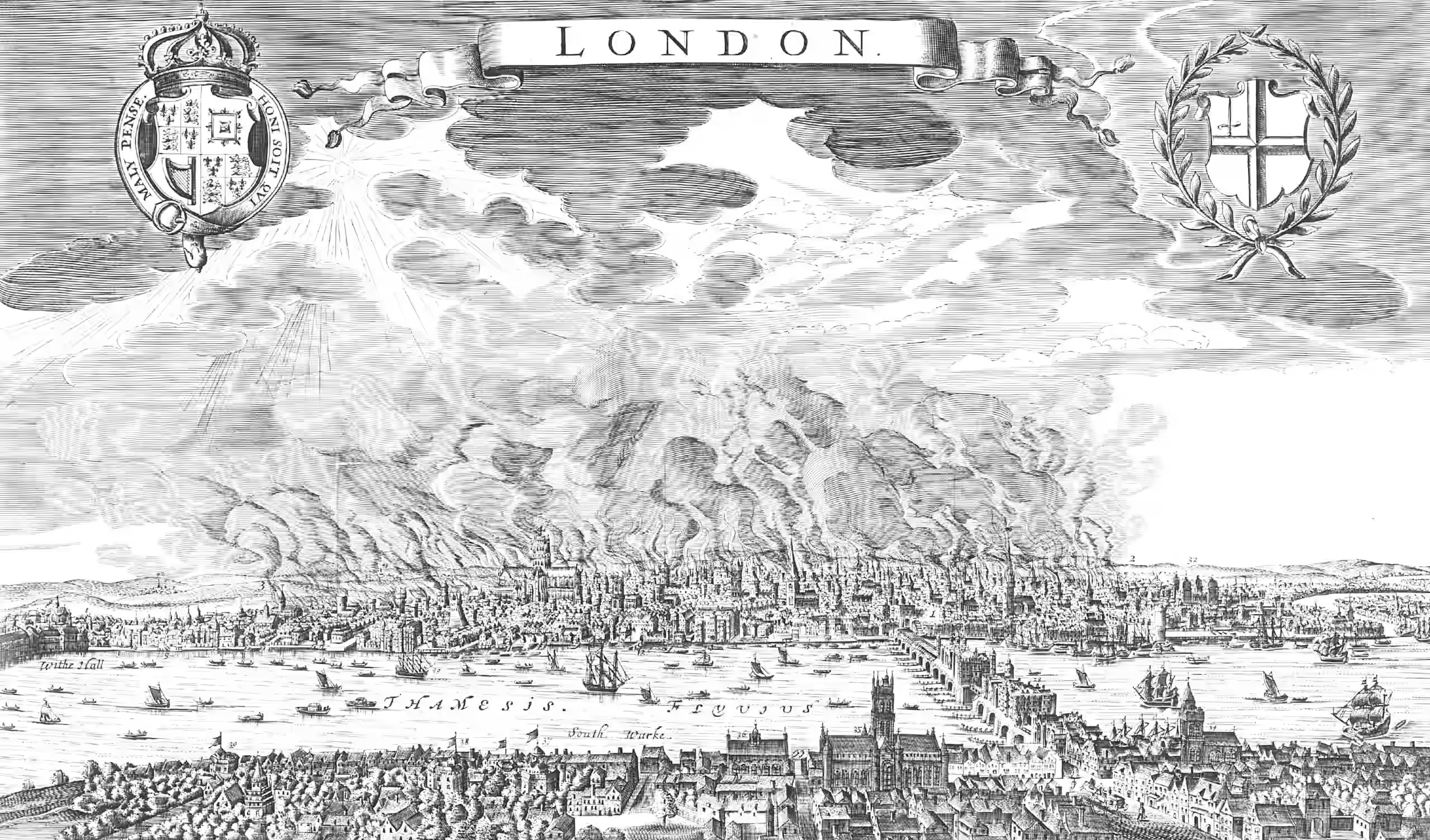
Here’s a list of things that interest me about London.
Thanks to Kathryn Smith and Rebecca Giggs for various hot tips.
1 OK London, whatcha got to entertain me?
I have a couple of days up my sleeve to do tourist stuff. What is the optimal tourist stuff for a guy like me to see in this town?
To clarify, I think I can best summarise what I’m interested in going to as “peak London” activities. This is an idiosyncratic definition that I hope encompasses the idea of things I’m unlikely to find elsewhere, which would appeal to me, being specific to London and high on intimate, visceral, and personal dimensions of experience. Going to look at Westminster doesn’t count because it’s just a building—one clogged with ten thousand people taking selfies and getting bored. Likewise, London Bridge. It’s a nice bridge, but in what sense is that experientially “peak”? How would that earn its place in my schedule?
No, for my day off I would answer the question: What’s some INTENSE LONDON BUSINESS?
I have been told that London is strong on History and also Things of Interest to the Scions of Oligarchs, so let’s lean into those for a starting point.
Robo Victoria and Albert (not the canonical name): In east London there’s a museum which is actually the storehouse for the more famous V&A museum. It has the most polarised TripAdvisor reviews I have read. Next to it, there’s the world’s tallest and longest tunnel slide.
Kew Gardens, hub of the Empire of Botany (not the canonical name) that helped Britain dominate the world. They’ve got all kinds of weird collections, all gussied up nicely (Bonsai, Cacti…)
The Grant Museum at UCL has a JAR OF MOLES.
The Viktor Wynd Absinthe and Monsters schtick looks kitsch enough that I probably wouldn’t go if I lived in London, but as a tourist I feel like I’ve got a licence.
-
Newspeak House, The London College of Political Technology, is an independent residential college founded in 2015. Our mission is to study, nurture and inspire emerging communities of practice across civil society and the public sector in the UK.
Five stars. I spent all evening arguing with a German cypherpunk on her way back from the CCC, and an Italian Civic Tech developer, and a Chinese researcher of AI Safety researchers.
Tube Strike! If the tube doesn’t shut down at least once, you haven’t really been to London. Meet strangers on the bus instead! Achieve critical mass in cyclist pelotons! Cram into the overground and then walk the last 5 km! God help you, do not attempt to drive; you’ll still be in traffic by the time the strike ends.
Village Underground seems like a cute venue where community meets raves.
Dennis Severs & His House sounds like a peak mix of fabulous history, style, and queerness.
Dennis Severs came to Spitalfields in 1979 and bought a derelict house saved by the Spitalfields Trust. He reconfigured it to tell the story of an imaginary Huguenot family who had lived there since it was built in 1724.
Dennis moved into 18 Folgate Street with a candle, a chamber pot and a bedroll – and the house became his life’s work.
Just your standard 1720s/1990s pastiche.
1.1 Historical engravings and prints
OK, this is a personal obsession of mine. I recognise it might not be for everyone. Listed here are the places that look like they have good stock at my price point (i.e. tending towards 1-to-3-digit-price facsimile engravings, copy engravings, or ephemera rather than 4-digit original old masters or whatever).
- Storey’s (Cecil Court, WC2)
- Grosvenor Prints has an appropriately antiquated website (WC2)
- Portobello Print & Map Shop (Notting Hill, W11)
- The Map House (SW3)
- Antiqua Print Gallery (NW10 + online)
2 London governance is cooked
London is a cabinet of governance curiosities. After more than a millennium of never-fully-resolved power struggles, it’s accumulated an incredible collection of bizarre case studies in not really redesigning anything—just adding more layers and carve-outs on top of the old ones.
Greater London looks like a single world city. Do not be fooled. It’s more like an unstable regional government that’s been created, abolished, and recreated, plus a set of pre-capitalist “corporate” endowments that do things I’d normally expect a state to do.
“London” contains a legally distinct city inside it: the City of London Corporation governs the Square Mile. The remaining 600 square miles of the capital are governed through the Greater London Authority (Mayor + Assembly) and the 32 London boroughs set up under the London Government Act 1963 (Q: Why does the governing act mention “the Temples” so much?).
The full story of how it got this way is beyond me, but I rustled up some highlights.
2.1 Prequel
Soon after 1066, William I issued a writ/charter confirming Londoners’ particular local laws and customs — a document the City still treats as foundational to its corporate continuity (see modern translation).
Then London leaned all the way in and didn’t lean out again. By 1132, the Crown had conceded a key privilege: Londoners could choose their own sheriffs, an office that elsewhere was a royal appointment. Soon after, the City’s chief magistrate became an internally selected civic office. The first recorded mayor, Henry Fitz-Ailwyn (1189), is the start of a continuous mayoralty up to the present. By 1215, the City’s liberties are explicitly shouted out in Magna Carta clause 13 (see a modern translation (Latin and English)/ background). All this makes London a ground zero for democratic governance, of an extremely idiosyncratic sort, in England.
2.2 The City of London stays small
By the 1600s, the built-up metropolis was spilling beyond the medieval City walls. In 1637, under Charles I, the Crown attempted an administrative reform that would have extended the City’s jurisdiction across the growing suburbs. But the City declined to expand. This disinterest in becoming bigger was named the Great Refusal (See also.)
The Crown presumably wanted tidier governance — plague control, order, taxation, all the usual early-modern state stuff. But another early-modern thing happened: institutional power struggle! The City — already a powerful corporate body with entrenched privileges — declined the expansion and kept its governance tightly bounded to more-or-less the old city walls. I’m not sure I understand the mentality, but this happens repeatedly in London’s history: when the metropolis grows, the institutions don’t naturally consolidate; new ones accrete around the gap and everyone preserves their own manor.
2.3 Patchwork metropolis
History from then on seems to show London as a mishmash of fragmented governance. The state didn’t so much run tings as tend a wild, weedy garden of parishes, vestries, boards, and carve-outs.
We can watch the Victorian state trying to trim things in the Metropolis Management Act 1855, which created a London-wide body for infrastructure and sanitation: the Metropolitan Board of Works.
The Act is worth skimming for the taxonomy (actually other bits might be worth skimming too, but I got tired). Its schedules enumerate a metropolis of parishes and districts, but also explicitly list extra-parochial places (“Schedule (C.)”). So here’s a category of London objects:
- The Close of the Collegiate Church of Saint Peter.
- Inner Temple.
- Lincoln’s Inn.
- Middle Temple.
- Staple Inn.
- The Charter House.
- Gray’s Inn.
- Furnival’s Inn.
I read this as “London normalizes exceptions”.
2.4 Engineering London’s governance
The Metropolitan Board of Works (MBW) was the Victorian attempt at metropolitan-scale capacity without integrated metropolitan-scale governance. It was created by the above-mentioned Metropolis Management Act 1855, staffed indirectly via parish vestries, and tasked with the physical problems of a rapidly expanding city (roads, sewers, bridges, embankments). Under the Local Government Act 1888, the Board’s powers were transferred to the new London-wide council.
The MBW was rife with scandal. In 1889 it was replaced by the London County Council, the first London-wide authority to be directly elected, with the statutory transfer set out in the same Local Government Act 1888. The process sounds acrimonious.
One thing the reform didn’t do, of course, was absorb the Square Mile into a unified London government. The City remained apart.
Reformers organised through groups like the London Municipal Reform League, arguing for a single democratic authority for the metropolis. Check out The City’s shadowy figure in the under-gallery for an account of some amazing Victorian-era turf wars:
The greatest threat came with an 1884 Government-backed reform bill. This aimed to create a single metropolitan council based on a reformed Corporation. The unreformed Corporation was having none of it and formed a committee to coordinate opposition. This collected a petition of 20,000 signatures – many probably fake or bought – and circulated anti-reform pamphlets; paid people to create intimidating opposition at public meetings; financed groups to stall the bill and mislead Parliament, and established an ‘Anti-One-Municipality League.’ Its spending totalled £19,500 – around £1.9 million today. As a result, the bill ran out of time in the Parliamentary session, and was not reintroduced
The Royal Commission on the Amalgamation of the City and County of London was an inquiry into whether unification might be a good idea. The City’s own submission is …defensive.
The Commission recommended unification in principle. London didn’t unify in practice. What did happen was a reorganisation of the County of London beneath the new London County Council: the London Government Act 1899 replaced vestries and district boards with metropolitan boroughs, explicitly described in parliamentary debate as transferring the powers of the old patchwork to borough councils.
The Square Mile (still watching it, right?) stayed special.
2.5 What the hell is the City now?
I’m not sure, but it’s weird, and very stably weird over time. Case in point: the City employs a senior official called the City Remembrancer, created in 1571, whose modern job description includes monitoring legislation and acting as a parliamentary agent.
Yep, a dedicated City officer, created in the 1500s, still has an officially acknowledged perch in Parliament’s gallery, tasked with tracking legislation that touches the City’s interests.
Inside the Square Mile, the governing machinery is its own ecosystem: wards, aldermen, a Court of Common Council, and an electoral culture tied to medieval guild structures.
A clean contemporary guide to the basic moving parts is the City’s own Wardmote Book, which sets out the City’s ward elections and the bodies involved. There’s also a livery system: the City states that livery companies are “integral to the City’s governance”, with liverymen participating in the selection of senior civic offices. The Common Hall assembly exists for liverymen to elect the Lord Mayor and Sheriffs.
The City retains a business vote. I mean, to be fair, there aren’t that many human beings who live in the City (fewer than 9,000), so it’s just as well there’s a business vote, otherwise it would be embarrassing. In 1994, 92 per cent of seats on the Court of Common Council were uncontested in any case. The latest version of the system is the 2002 act. The parliamentary discussion about this got spicy. “CHAIRMAN: If you seek to argue that they have no power to do this, Mr Matson, you no doubt you will be able to have the matter brought before the courts to seek to quash it in a proper basis, but not here.” Also, they shout out Melbourne as a comparative case study.
The City is also a long-lived corporate manager of funds and trusts. It operates multiple funding streams, including City’s Cash, described by the City as an endowment “built up over the last eight centuries” and used to finance activities “mainly for the benefit of London as a whole”.
Bridge House Estates—now branded as the City Bridge Foundation—was established roughly nine centuries ago to maintain London Bridge and now looks after multiple central London crossings.
The relationship between the City’s electoral system and modernist institutional design is reminiscent of the relationship between a seagull and a quadcopter.
2.6 Greater London: The bit that is not the City
Above borough level, London’s regional governance has repeatedly been, as we’d say now, “phoenixed”.
In 1965, the London Government Act 1963 created the Greater London Council (GLC) and the modern borough structure. The GLC was later abolished by the Local Government Act 1985. London then spent the late 20th century with strategic functions dispersed among multiple bodies. After the abolition of the GLC, “a complex web of bodies” handled aspects of city-wide policy. Thatcher nuked the Greater London Council in the ‘80s, apparently as a power play against the left-wing GLC leadership. Regional government returned in 2000 via the Greater London Authority Act 1999 establishing the Mayor of London and the London Assembly.
So now Greater London has a Mayor, after a huge hiatus — as opposed to the Lord Mayor of the City of London, who has been there uninterrupted for centuries. Because this is dumb and confusing, the City itself maintains an official explainer distinguishing the Lord Mayor of the City of London from the Mayor of London.
2.7 Institutions that survive by becoming owners, trustees, and exception areas
If we take a step back, London’s administrative oddness has themes. The same techniques recur across centuries:
- preserve a privileged jurisdiction inside a growing metropolis (the City after 1637);
- tolerate patchwork and exception areas until infrastructure forces a partial rationalisation (1855);
- build metropolitan capacity through indirectly accountable bodies, then replace them when legitimacy collapses (MBW → LCC);
- attempt unification, then settle for reorganising everything except the Square Mile (1890s);
- carry political access forward through specialised offices (the City Remembrancer);
- embed wealth and function in endowments and trusts that outlive normal municipal cycles (City’s Cash, City Bridge Foundation, Epping Forest conservatorship);
- re-cut regional government when national politics demands it (1963, 1985, 1999).
Now that we know all this, the steampunk detective radio play called: Victoriocity (set in “Even Greater London”) is my next recommended stop.
2.8 Forward-facing policy setting
OK WHAT A WILD RIDE. HERE, HAVE SOME YIMBY ARTICLES AS A PALATE CLEANSER:
3 Transport
3.1 Bikes
The bike infrastructure is… incredibly good. World class. I was not expecting this, but I guess that, at least in central London, people were like “bike lanes cannot make this shit show worse YOLO.” Strong recommend.
Also strong recommend, local cult bike brand Brompton. Helpful guides exist to this cult, e.g. Where Your Brompton is Welcome in London.
3.2 The tube
Definitely an adequate public transport system. And iconic! People warn me that some stations are prone to muggings late at night. I have not yet been mugged.
The real test of the quality of the Tube is what happens when there is a workers’ strike. This is probably a PEAK LONDON experience, watching a city grind to a halt as the overloaded surface infrastructure struggles to move a few million people on a road grid they never really got around to fixing after the Great Fire. Having the whole city cry “Your plans are naught to me! I grind your schedule to dust beneath overcrowded rush hour traffic” is somehow peak London.
Fun observation: there seems to be no universal social norm amongst Londoners that prevents people with raging respiratory illness from catching trains and then coughing and/or sneezing copiously into their hands.
As I write these words, there are detonations on all sides, like a bombardment of nasal depth charges. The holidaying Singaporean family I am sitting next to are horrified.
A colleague claims this is to do with the in-migration of “Asians”. If so, the causation must be indirect, because overwhelmingly it seems to be white people sneezing into the hand they shake mine with. The only way asian in-migration could cause this is if it were some kind of virological warfare strategy by autochthonous Londoners to make the city uninhabitable for the new arrivals, in a kind of snotted earth strategy.
3.3 Regional trains
Functional but expensive and unnecessarily frustrating.
Archetypal experience: at King’s Cross station, I foolishly arrive 20 minutes early. There is nothing to do for 14 minutes because LOL there is NO POSSIBLE WAY TO KNOW what platform any given train will arrive at before it does so. About a thousand people stand in the entrance hall, staring at the departures board waiting for the inscrutable god of switching to guide a train to a destination, unable to move for fear of getting a bad seat when the mad rush begins. At 6 minutes before my train’s departure a platform is assigned — “platform 9” it says — and a couple of hundred people surge out for the crowd to board. “Can I buy a sandwich in 6 minutes and still make it?” I ask myself, having failed to do so while pinned to the departures board. LOL no.
Amazingly there is a wheelchair section in the train, although anyone who can traverse this enormous, crowded station in 6 minutes in a wheelchair deserves not just a spot in the wheelchair section but also a small congratulations ceremony where they are awarded a cooling refreshing beverage and a free manicure or something.
I’m sure there is some profound reason the trains cannot possibly be predicted, or at least disclosed, in advance at the train station. Like, is it an ingenious plot to confuse the ruskis who might want to very specifically bomb the train to Harrogate or something?
Or maybe the trains are just so damned advanced and frequent that the human station managers just give up? I would accept this if it got us some kind of extraordinary train speed, or if they could achieve other markers of competence such as successfully having running water to wash your hands with in the washbasin, but their performance on these fronts is indifferent.
Anyway, the most unrealistic part of Harry Potter, IMO, is that there is no way the kids could have known that their train would leave from platform 9 and ¾, because in all likelihood it would have arrived at platform 8.3, and the little magical tykes would have missed the school term.
3.4 Driving
Looks depressing and horrible.
4 Class
I’m baffled by the UK class system, as is traditional for outsiders. Being baffled by the UK class system is very much part of the recommended outsider experience. We all enjoy, I think, being confused by the cultural hijinks of a weird island nation that hasn’t had a thorough socioeconomic reset since the last time it was thoroughly invaded a millennium ago, or at least not as much as its neighbours.
So! Some notes for my own understanding.
I’m not going to talk about accents. That is a whole can of worms.
4.1 Shopping
I think I can see class in the shopping choices people make. In Britain, supermarkets seem to map out social class. While Australia’s Coles or Woolies don’t carry much status baggage, in the UK a supermarket choice signals something more about a person’s social position and taste.
At the top end is Waitrose, leaning into organic veg, nice wine, and “tasteful” interiors—basically shorthand for the comfortable middle class. Marks & Spencer (M&S) sits alongside it, with pricey ready meals and a food hall full of treats rather than essentials. Sainsbury’s is a polite middle option—solid, reliable, slightly aspirational but still everyday. Tesco is the country’s main supermarket, stretching from basic to premium but leaning toward basic. I find this confusing because the first time I saw Tesco was in Thailand, where it was coded as fancy.
TBH the interiors of each store don’t look that different to me, the prices don’t either, and they all have the same trashy gossip magazines at the checkout. Everything is expensive everywhere. Tesco seems to avoid stocking dark chocolate or any seasonings with even a hint of chilli heat, except in bulk family-sized packs marketed to South Asian shoppers; so there’s some ethnic/cosmopolitan segmentation too, I guess. Waitrose seems to have more “British-grown” produce than the others, so I guess local food is a class privilege? I’m curious whether this is specifically a London thing; maybe local stores in the countryside are heaving with local produce, and it’s only those London folks flying their berries in from Morocco.
Below those local brands, Aldi and Lidl seem generally “cheap”-coded, but with the cost-of-living crisis even people who look rich seem to have Aldi groceries at home.
Also, department stores still seem big here, or at least culturally salient; I’m less sure what their actual turnover is. And they’re heavily class-coded too. More heavily class-coded? Harrods is old-school luxury—tourist heaven, chandeliers and caviar counters. Selfridges is modern luxury, more about design and art. M&S is middle-class comfort: safe, familiar, mostly not flashy.
AFAICT, people don’t go to department stores at all if they’re lower-class-coded; instead they get their stuff at Argos, I guess? I cannot work out the point of Argos. It’s supposed to be no-frills essentials in a catalogue-store format. Everything I tried to get there was cheaper and more convenient from amazon.
The bakery coding is similar (Gail’s is middle-class, Greggs is working-class, Pret and Paul are in between).1 This is… I guess, more familiar to me from Australia, where people also invest in bakery-based social signalling.
- Reddit: UK supermarket stereotypes
- British Supermarkets Explained (video)
- HuffPost on middle-class supermarkets (many more supermarkets ranked in terms of political and income demographics)
4.2 Arts and music and all that
Is London cool? Is it a cultural capital? What does that even mean? I’m not sure, but people have opinions.
🚧TODO🚧: write about arts scene.
Research reveals stark class inequalities in access to the creative industries - The Sutton Trust
‘Cool’ London is dead, and the rich kids are to blame
The future is a clean, dull city populated by clean, dull rich people and clean, dull old people. The future is joyless Michelin starred restaurants and shops selling £3,000 chandeliers.
5 Attitudes to heating
My God. People here are obsessed with the high cost of their heating. I knew this before I arrived. There are adverts at every Tube station for cheaper energy suppliers. I was ready to be sympathetic to their plight. My sympathy has, er, cooled now that I’ve seen what people around me are trying to heat, and how.
At least in the places I’ve been, buildings have ancient single-pane windows and leaky doors, and these barn-like structures are heated by a constant roar of gas heaters, usually with dumb design choices like putting the radiator just below the window on an exterior wall, which minimises how much heat the building retains. When the space gets too hot, do they turn down the thermostat? No, they do not. It seems to be completely culturally normal to open windows in winter while the heating is blasting rather than figure out how to use the thermostat controls. Some people will not be happy until the very laws of thermodynamics are repealed.
Update: Apparently I am misinterpreting this. In fact, the windows are open to air places out, not to cool them down. So the cultural weirdness is that people don’t turn the heating off when airing out the space? And they also leave the windows open for long periods of time because their buildings are simultaneously too leaky to heat but not leaky enough to breathe?
ALSO, what is it with the prevalence of gas heating? Even if you think that climate change isn’t a thing, why introduce an extra supply-chain dependency on imports? And why not get electric heat pumps so we can have heating in winter and cooling in summer?
IDK, I think they just aren’t very good at living in the climate they have, no matter how I try to rationalise the specific ways this manifests.
6 Bargelyf
So many houseboats and bargehomes on the canals!
In contemporary London, living on a canal boat is less a heritage reenactment and more a housing market adaptation. The London Assembly’s “Moor or Less” report notes that rising rents and house prices have pushed more people onto the water, estimating up to ~10,000 people living across London’s waterways (it cites roughly 100 miles of canals plus 42 miles of the Thames). Fun thing to note: the number of boats rose faster than the supply of moorings and essentials like water points and waste disposal.
The institutional setup is characteristically baroque English legacy weirdness. Much of the network is run by the Canal & River Trust, a charity created in 2012 from British Waterways’ assets. To live aboard you need a licence; if you don’t have a lawful “home mooring”, you can claim to “continuous cruising” under British Waterways Act 1995, section 17: the Trust says you must be on “bona fide navigation” and (generally) not stay more than 14 days in a given neighbourhood.
“Permanent”: London moorings are scarce and often priced like the kind of scarce urban land rights that boats are supposed to supplement; CRT leases many moorings via auctions and the prices can reach eye-watering levels in prime spots. If you’re a continuous cruiser, the bureaucracy treats “needing to stay within commuting distance of work or school” as an unacceptable reason to linger, so “moving house every fortnight” is the deal. Even though you’re afloat, council tax can apply to houseboats as domestic property, by the logic that houseboat crowding still puts pressure on the council.
They do look charming though.
7 London is biggggg
Elsewhere discussed: Urban scaling laws, which predict the distribution of city sizes—for a given nation-state, how many people are in the biggest city versus the second biggest, etc.
London breaks those laws; it makes up too damn big a chunk of the UK’s population and economic output to fit the usual patterns. The term of art for this is “London behaves like a primate city”: it is so dominant in population and economic output that it sits off the top end of the usual scaling laws that relate city size to indicators like GDP or innovation. When you plot European cities on the standard superlinear urban scaling curves, London (and IIRC its French counterpart, Paris) tends to appear as an outlier “dragon‑king” megacity rather than just the next step up in a smooth hierarchy (Arcaute et al. 2015; Bettencourt and Lobo 2016). Something about being the former capital of a global empire, perhaps?
8 Cartography
London is a good city to map, based on how many maps have been made.
Everyone in London speaks in postcodes. “I live in NW3—can we get coffee there?” is a thing we could say. Notably, the print shops I mentioned above have postcodes listed. There are many guides to decoding the postcodes, but here is the one I used: Decoding London Postcodes, The Easy Way. tl;dr: NW9 is northwest of the middle and farther away from that middle than NW1. We can guess most of the rest.
There is of course a cool history; the modern postcode grew out of an older postal district system. Of course, it totally clashes with other administrative units.
- Iris Murdoch’s London (i.e. from her books) has been mapped. Much Soho wow.
- Folded maps by Urban Good Paper maps! of urban nature and footways and such! Made by a lovely chap I met over haggis, Charlie Peel.
- Of course I should mention Beck’s iconic Tube map
- Lauren Leek’s map of underrated eateries
- London Inequality Explorer
- Relatedly, Lauren Leek’s Latte Line map, with Political economy back story
- londonmaxxxing, the london tech “heat” map
- Stay Cool London — Air-Conditioned Restaurants, Pubs & Cafes
- London’s Water Fountains
- Infinite London Ok this is actually kinda the opposite of mapping London.
9 Sexy, queer London
- Of course I should have mentioned Damien Frost’s exquisite documentation of the Night Flowers (Frost 2016)
- WAX feels very London: a sex‑positive events empire that built its own app, launched it with a big multi‑brand party at Heaven in 2023, and iterated it into WAX/WeAreX— a hybrid dating‑and‑events platform for kink‑ and queer‑friendly, sexy-time communities that treats London’s nightlife as its home turf while steadily scaling outward. Includes adorably local features such as integrating with the National Health Service STI tests. Looks like excellent community design for, like, bangs. As such, I’m calling this a distinctive local sexy institution.
- The Institute of Sexology is a literal sexual institution, at the Wellcome Collection. Damn, I should go.
10 London fan-fiction
So much. Some lesser-known picks:
- Fallen London “Forty years ago, London was stolen by bats.” —Local interactive gothic horror comedy
- Victoriocity (set in “Even Greater London”) asks: What if the 19th century but the queen was an immortal battle tank? and then detectives.
- Edward Hine, Forty-seven Identifications of the Anglo-Saxons with the Lost Ten Tribes of Israel
11 Material goods
- Freecycle: Museum Freecycle UK Group.
- UK used-fashion market Vinted is the best I have seen so far. Not “good” in the sense of “this website is well-designed and easy to use”. No, it’s total retrograde garbage. But the market is good despite that, because 80 million British party animals are flogging their glad rags on there.
12 Coffee
Survivable, albeit in a grim joyless kind of way where we are either drinking burned coffee pod sludge, or eternally questing for the 1 in 20 cafés that can hire baristas worthy of the name.
13 References
Footnotes
I will go on record saying that Gail’s has the best chocolate babka, like, anywhere.↩︎