
Majority illusions and filter bubbles

Toxic cascades, squeaky wheels and social dark matter; the difficulties of estimating what all people think from the ones you see

2019-09-22 — 2025-02-17

quality 5.8

Wherein the Reader Is Apprised That, in Homophilic Social Networks, a Few Highly Connected Hubs Cause Rare Opinions to Be Made to Appear Common in Local Samples, Thereby Biasing Prevalence Estimates.

causality
collective knowledge
cooperation
distributed
game theory
networks
social graph

Inference is easy when they teach you about it in school, but in the real world, it’s hard. Imagine you’re trying to gauge how many cows in a herd have a particular quality — say, a genetic trait linked to higher milk yield. Since cows mostly mix evenly with one another, you can simply select a few at random and get a pretty accurate picture of the whole herd.

Now, consider a human scenario. Suppose you want to estimate the prevalence of a niche political opinion. You might ask a random person how many of their friends share that view. However, because of the Majority Illusion, even if only a small fraction of people hold that opinion, a few highly connected individuals (the social “hubs”) can make it seem much more common. These hubs appear in many people’s friend circles, so their rare opinion is overrepresented in local samples, even though it’s rare globally.

This is one of the challenges of inference on social graphs that really messes with us when we try to understand opinion dynamics. This insight is one of those that seems trivial in hindsight, but people are terrible at articulating in advance. Related, perhaps a consequence of this, is pluralistic ignorance.

Another major problem is that the people who participate in public discourse are weird, and moreover, the people whose opinions are disseminated on social media are even weirder. This is the social dark matter problem; you are going to see stuff that is way crazier than you would expect from the general population.
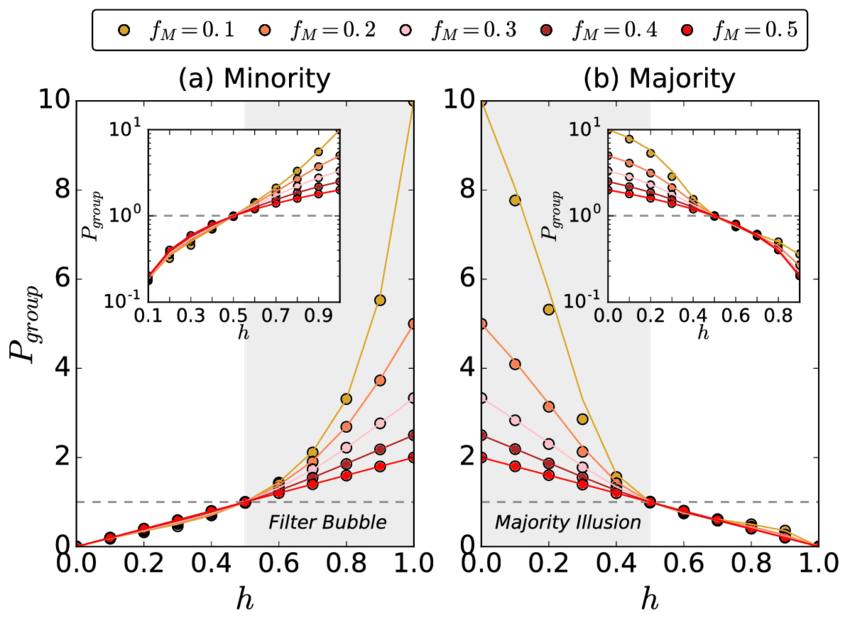
Figure 1: In homophilic networks (0.5 ≤ h ≤ 1), the minority overestimates their own size (filter bubble) and the majority underestimates the size of the minority. The insets show the same information on log scale to make the amount of underestimation and overestimation comparable. As group sizes become more disproportionate, perception bias increases (Lerman, Yan, and Wu 2016).

Here, I would like to think about things that resemble the majority illusion.
Figure 2

1 Incoming

  • Duncan Sabien, Social Dark Matter

  • We’re getting the social media crisis wrong

  • The Distortion Is Inherent in the Signal

  • My Stepdad’s Huge Data Set

    There’s an analogy to be made with US politics: political analysts refer to “what the people want,” when in fact a fraction of “the people” are registered voters, and of those, only a percentage show up and vote. Candidates often try to cater to that subset of “likely voters”— regardless of what the majority of the people want. In porn, it’s similar. You have the people (the consumers), the registered voters (the customers), and the actual people who vote (the customers who result in a conversion — a specific payment for a website subscription, a movie, or a scene). Porn companies, when trying to figure out what people want, focus on the customers who convert. It’s their tastes that set the tone for professionally produced content and the industry as a whole.

2 References

Acemoglu, and Ozdaglar. 2011. “Opinion Dynamics and Learning in Social Networks.” Dynamic Games and Applications.
Bessi. 2016. “On the Statistical Properties of Viral Misinformation in Online Social Media.” arXiv:1609.09435 [Physics, Stat].
Cha, Haddadi, Benevenuto, et al. 2010. “Measuring User Influence in Twitter: The Million Follower Fallacy.” In Fourth International AAAI Conference on Weblogs and Social Media.
Costello, Srivastava, Rejaie, et al. 2021. “Predicting Mental Health From Followed Accounts on Twitter.” Collabra: Psychology.
Dittmar, and Seabold. 2015. “Media, Markets, and Radical Ideas: Evidence from the Protestant Reformation.” Centre for Economic Performance Working Paper.
Dodds. 2017. “Slightly Generalized Generalized Contagion: Unifying Simple Models of Biological and Social Spreading.” arXiv:1708.09697 [Physics].
Dodds, and Watts. 2005. “A Generalized Model of Social and Biological Contagion.” Journal of Theoretical Biology.
Farrell, and Shalizi. n.d.a. “An Outline of Cognitive Democracy.”
———. n.d.b. “Evolutionary Theory and the Dynamics of Institutional Change.”
Goel, Anderson, Hofman, et al. 2015. “The Structural Virality of Online Diffusion.” Management Science.
Gomez-Rodriguez, Leskovec, and Krause. 2012. “Inferring Networks of Diffusion and Influence.” ACM Trans. Knowl. Discov. Data.
Granovetter, Mark S. 1973. “The Strength of Weak Ties.” The American Journal of Sociology.
Granovetter, Mark. 1983. “The Strength of Weak Ties: A Network Theory Revisited.” Sociological Theory.
Jackson, Malladi, and McAdams. 2019. “Learning Through the Grapevine: The Impact of Noise and the Breadth and Depth of Social Networks.” SSRN Scholarly Paper ID 3269543.
Kellow, and Steeves. 1998. “The Role of Radio in the Rwandan Genocide.” Journal of Communication.
Lee, Karimi, Jo, et al. 2017. “Homophily Explains Perception Biases in Social Networks.” arXiv:1710.08601 [Physics].
Lerman, Yan, and Wu. 2016. “The ‘Majority Illusion’ in Social Networks.” PLOS ONE.
Leskovec. 2012. “Information Diffusion and External Influence in Networks.” Eprint arXiv:1206.1331.
Mahmoodi, Bang, Olsen, et al. 2015. “Equality Bias Impairs Collective Decision-Making Across Cultures.” Proceedings of the National Academy of Sciences.
Olteanu, Castillo, Diaz, et al. 2019. “Social Data: Biases, Methodological Pitfalls, and Ethical Boundaries.” Frontiers in Big Data.
Robertson, del Rosario, and Van Bavel. 2024. “Inside the Funhouse Mirror Factory: How Social Media Distorts Perceptions of Norms.” Current Opinion in Psychology.
Rogall. 2014. “Mobilizing the Masses for Genocide.”
Saichev, and Sornette. 2011. “Hierarchy of Temporal Responses of Multivariate Self-Excited Epidemic Processes.” arXiv:1101.1611 [Cond-Mat, Physics:physics].
Valente, and Pitts. 2017. “An Appraisal of Social Network Theory and Analysis as Applied to Public Health: Challenges and Opportunities.” Annual Review of Public Health.
Vega-Oliveros. n.d. “Influence Maximization Based on the Least Influential Spreaders.”
Watts, and Dodds. 2007. “Influentials, Networks, and Public Opinion Formation.” Journal of Consumer Research.
Zafarani, Abbasi, and Liu. 2014. Social Media Mining: An Introduction.