Intentional language
The point of teleology, Cognitive ergonomics of anthropomorphising
2026-01-23 — 2026-02-28
Wherein the Wason Card Puzzle Is Recast as Underage Drinking, and Dennett’s Intentional Stance Is Employed to Ease Prediction of Machines, While Moral Patienthood and Pareidolic Overshoot Are Set Aside.
The Wason selection task is a logic puzzle that uses a set of cards Figure 1.
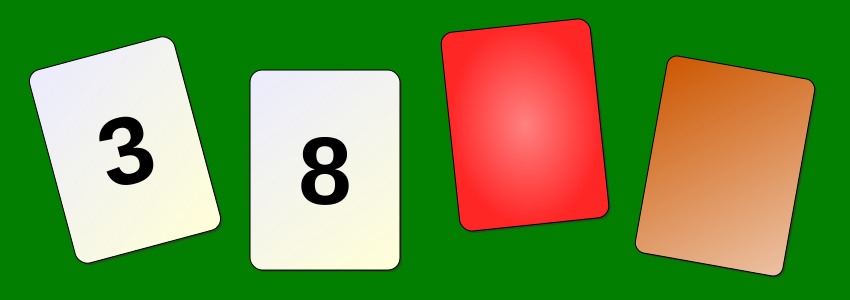
In its abstract form, the task is notoriously difficult. To test the rule “If P, then Q”, logic says we need to check the P case (to see whether it has Q) and the not Q case (to see whether it has P). Most people fail to flip the “not Q” card and fall prey to confirmation bias.
But when we frame the task as a social problem instead of a logic puzzle, we suddenly get much better at it Figure 2.

Now that the logical problem is framed as a social problem, it becomes easy for our social-ape brains. Almost everyone knows to check the beer drinker (P) and the 16-year-old (not-Q).
Why is the second task so much easier? Evolutionary psychologists like Leda Cosmides and John Tooby (Cosmides and Tooby 1992, 1994) argue that human beings haven’t evolved to be general-purpose logic processors. Instead, we’ve evolved specialized “modules” for social exchange: our brains are optimized for reasoning about social contracts, intentions, and agency.
For our ancestors, survival depended on stuff like the ability to detect “cheaters”—those who take a benefit without paying the cost or following the rule. It’s totally reasonable to suppose that we tend to be good at reasoning about the intentions, obligations, and transgressions of other agents.
1 The Intentional Stance
If our most powerful cognitive hardware is dedicated to social reasoning, it follows that we might reason better about complex systems when we treat them as social agents.
This is what philosopher Daniel Dennett calls The Intentional Stance. Dennett argues (Dennett 1998) that there are three ways to predict the behaviour of a system:
- The Physical Stance: Predicting based on physics and chemistry (e.g., “The water will boil because of heat”).
- The Design Stance: Predicting based on how something was built (e.g., “The alarm will go off because the timer is set”).
- The Intentional Stance: Predicting based on what the system “wants” or “believes” (e.g., “The chess computer is trying to protect its Queen”).
While the physical stance is often claimed to be the most “accurate”, it’s kinda unwieldy. If we want to predict how a Large Language Model (LLM) or a complex algorithm will behave, talking about it purely algorithmically is clunky and unintuitive (e.g., “The model will output token T with probability P given context C because of the weights W and the training data D…”). The Design Stance is better, but still complex (e.g., “The model is designed to predict the next token based on patterns in its training data…”). But saying “The chess computer is trying to protect its Queen”, in an intentional style, seems pretty compact.
FWIW, I’m not even convinced the intentional stance is especially “inaccurate” as such; we don’t really know what intentions are for general physical systems.
But! Social convention says we don’t get away with using intentional language, at least for some classes of objects. If I talk in a biology class about dogs as thinking, or on the internet about LLMs as thinking, then I’m likely to be accused of anthropomorphism—the attribution of human traits to non-human things. This is commonly regarded as a “category error” or a sign of intellectual laziness.
OTOH, the Wason task suggests that anthropomorphism might actually be a form of cognitive ergonomics. Maybe I see intent everywhere because it helps me think better about systems. By using intentional language—words like wants, knows, believes, tries—we are “porting” a complex technical problem into our brain’s most high-performance processor: the social reasoning module.
Just as we find it easier to spot a “cheater” in a bar than a logic error on a card, we find it easier to debug a system by imagining its “intentions.” Admitting intentional language into our technical descriptions isn’t necessarily a claim that the machine is “conscious”; rather, it is an admission that we are human and we think best when we pretend the world is looking back at us.
Maybe even our reasoning about humans is also anthropomorphizing, in the same sense? I am unsure about this, but I cannot find a crisp way of making the distinction.
2 Intentional language is not the same as moral patienthood
OK, so I ascribe a system “intents” and “wants”. Does that mean that I’m treating the system as a moral patient, with rights and interests that I should respect?
Nah, we need to be careful about that too. There’s a whole other question about whose wants and needs deserve consideration, and whether they have “conscious experience” or “qualia”, and whether that means we need to care about them. I have relatively few thoughts about that. Sounds interesting, but also like a philosophical tarpit I don’t want to step into.
3 Overshoot
What does it look like when we lean too hard into intentionality? Our brains are so well-optimized for social pattern-detection that we often see “agency” where there is only noise. This is Pareidolia—the tendency to see faces in clouds or burnt toast—and it can lead us down a rabbit hole of metaphysical overreach.
If we find the intentional stance useful for a dog, then a computer, then a “smart” thermostat, where does it end? We risk sliding into a functional Panpsychism, the belief that consciousness or mind-like qualities are fundamental properties of all matter. Or perhaps we find ourselves returning to an ancient Animism, treating the river, the forest, and the thunderstorm as entities with their own agendas.
Is that bad though? Is this “overshooting” an actual problem? From a strict materialist perspective, it might be a delusion (although, once again, what even are intentions?). Pragmatically, if an animistic view of a forest leads a community to manage its resources more sustainably than a “resource-extraction” view, then the “error” brings biological utility. Similarly, if treating a complex neural network as a “personality” allows a researcher to predict its failure modes better than a statistical analysis would, the anthropomorphism has paid its way. We may have to accept that our brains are biased toward seeing ghosts in the machine, but maybe that works just fine.
4 And thus Marx
Now I have talked myself into contradicting another statement I made on this blog. Under conflict theory I mentioned I was not well-disposed to theories that assume an “us and them” might be in conflict, because it doesn’t seem credible to me that the social groups in most conflict theories actually organize.
But maybe it is a “good enough” cognitive crutch to talk about “workers” and “capital” as if they each were egregores with intentions and agency, even if they are really just metaphors for complex social dynamics?
It seems possible that by opening the door to talking about LLM agents as if they were coherent intelligent agents, I might also open the door to describing the proletariat as if it were a coherent agent?
Unclear. I need to think on this.