Agency under bounded compute and information
Between the Good Regulator and the Big World
2026-04-29 — 2026-08-04
Wherein a Taxonomy of Eight Rival Frameworks for Bounded Agency Is Assembled Into a Table, and It Is Argued That Unlimited-Compute Demons Require, Absurdly, a Larger Universe to Think In.
One of several notebooks I started on the same underlying problem. The others are homunculi (compute split across self, other, and reflective sub-models) and economics of cognition (compute as a “substitutable factor of production of cognition” or something like that).
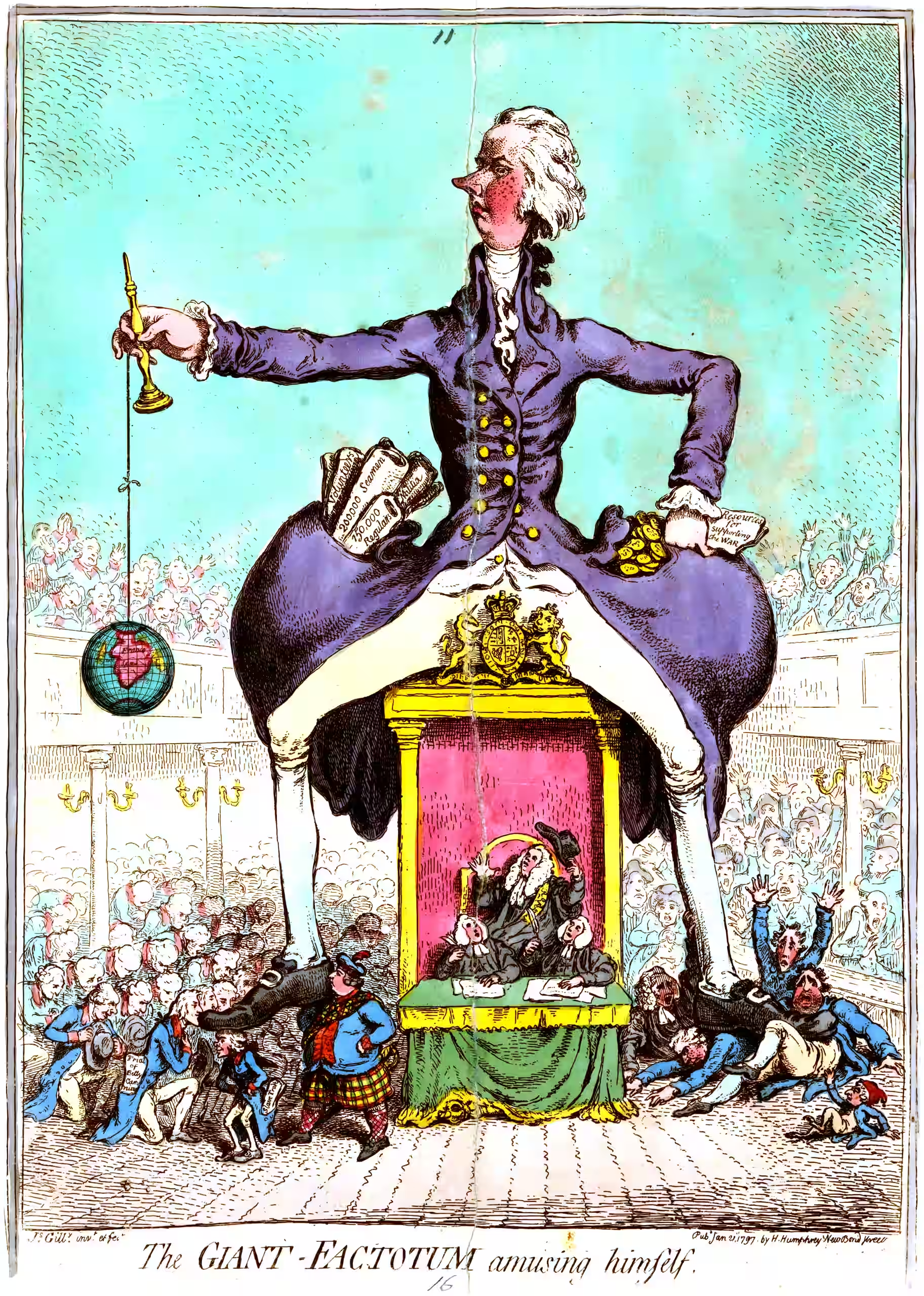
One thing that’s especially baffling about economists, AIXI, and classical Bayesian agent theory is that they often treat the “agent” as a Platonic ideal, with infinite compute and perfect information, or at least as something to be criticized for deviating from that asymptotic ideal. We all know this is not quite right. We have known this since the original Von Neumann-Morgenstern axioms, and we periodically try to patch it with ad hoc bounded rationality fixes. None of these fixes are quite as theoretically satisfying, so even as we make the disclaimers, the unbounded agent seeps into our reasoning in all kinds of ways.
Maybe there is no “right” way to do it except getting elbows-deep in the empirics of what humans do. That is one potential state of the world.
Nonetheless, I think a better (more contiguous, more compact) theory of bounded agency might help. Maybe not something that “explains everything” about humans in every detail. But surely something that explains better what regularities we might find in finite reasoners in general? I do not think we can avoid at least trying to devise one, because it turns out that we are beginning to share our world with new types of reasoning agents, and a theory of what we might share in common feels existentially important. One thing we for sure share is boundedness.
Here is yet another attempt (this blog is racking them up) to understand wtf is going on with achievable, bounded agents. I walk through the salient concepts and then get snarled in the details of each of them.
1 Full-information, unlimited compute
If we have complete information about the initial conditions of the universe, and unlimited compute, then it does not seem natural to classify anything as possessing “agency”; we can see the whole of the universe, up to quantum fluctuations, by stepping our perfect simulator forward in time. There are no decisions to be made, merely consequences to be observed.
But we might also find that thinking of ourselves as horologists to the clockwork universe is unsatisfactory as a model for us doing the modelling. I, for example, will never be this omniscient being. To know the whole of this universe, I would need another, much larger, universe to store the information in, to build the computer to do the simulation, and so on. I mean maybe that happened and I am in the simulation of some omniscient agent? Even then, that omniscient agent is not a great model for me.
AIXI relaxes the first assumption (we don’t know where the universe started, we just arrived in it with an effectively infinite computer and need to work out what it is computing). That still doesn’t feel like enough of a relaxation. More generally, “agency” seems like it might accrue to entities which need to learn to act with both bounded information and bounded compute.
It sounds like it might be time for a quadrant map! That sometimes helps. The two axes are information about the world (complete vs bounded) and compute available (unlimited vs bounded).
- Complete information, unlimited compute. A Laplacean demon. Step the perfect simulator forward in time. There is nothing here we would want to call agency; the universe just runs.
- Bounded information, unlimited compute. AIXI and friends. We grant ourselves an environment hypothesis class weighted by Kolmogorov complexity and let the agent “solve” it in closed form. Computationally troubling, but a background against which much agent foundations theory plays out.
- Complete information, bounded compute. An oracle that computes too slowly to act in time. This seems maybe relevant to weather forecasting or replay buffers, but not to agency proper, so I won’t talk about it much.
- Bounded information, bounded compute. Where we and large language models and bacteria and politicians can be found. The thesis of this notebook is that this combination is the primary one we need to understand to “know about agents like ourselves”, and that the other three are idealizations that probably do not have much useful to say about people.
2 Two senses of agent
“Agent” is doing two jobs in this notebook, and I have been sloppy about which. Sometimes it means a bounded observer: a system embedded in a world it must make inferences about from inside. Sometimes it means a bounded actor: a system that also changes the world it is sampling. The observer’s problem is “estimation under openness”. The actor’s problem — what “acting well” can even mean from inside — is here.
The two problems do not factor cleanly. Control theory calls the clean case the separation principle: in LQG the optimal controller is an optimal filter composed with an optimal actor that trusts the estimate. Much of what is interesting below is where that factorization fails — dual control (acting partly in order to learn), the good regulator theorem (acting well requires containing a model), performative prediction (being read is already acting). POMDP-as-agent below attempts to give structural form to the separation principle by choosing a nice low-complexity variant
The quadrant map axes classify agents by their endowments, but the criteria that end up doing the work — the admissibility conditions end up looking different. Specifically, I didn’t handle the problem of self-containment, which in hindsight is where the Cantor trap gets in.
3 The good regulator in the big world
The internal model principle, AKA the “good regulator theorem”, says, roughly: any agent that does well in an environment must contain a model of that environment. Conant and Ashby (1970) is the original cybernetics variant, which is to say, mathematical but a little woo; Francis & Wonham (Francis and Wonham 1976) give the control-theoretic version; Huang et al. (2018) is a recent tutorial. We start with the hypothesis that if it is doing ok, an “agent” “contains” a “model” of its “world”, for some definition of those terms.
The big-world hypothesis says: the environment is strictly bigger than the agent — there is no point at which the agent can ever have “solved” the world.
Together, these suggest that when thinking about agents, we need to think about lossy compression of the world. What kind of compression is the agent’s internal model? Which features might it store? What is it sufficient for? When does the residual look like noise, and when does it look like the world ambushing us? What can we afford that still works?
Somewhere in this porridge of formalisms we might find floating a soggy mass corresponding to bounded rationality, which reminds us that we cannot afford the naïve model, the territory-as-map.
4 Prior art
Short notes on each. I got an LLM to fill in the columns of the table for my edification. Future-me, do not be alarmed by the count — these are mostly variations on a single optimization problem, viewed from different traditions. I suspect some of these collapse into each other under some trivial translation of terminology, but I know not which.
| Entry | Operates on | Where bound enters | C | St | Sc | Side |
|---|---|---|---|---|---|---|
| Resource-rational analysis | cognitive strategies | soft cost on cognitive operations | ✓ | ~ | ✗ | actor |
| Bounded optimality | programs for architecture \(M\) | hard feasibility | ✓ | ✗ | ✗ | actor |
| Rational metareasoning | computations, online | per-step VOC cost | ✓ | ✓ | ~ | actor |
| Information-theoretic bounded rationality | policies | KL budget vs prior | ~ | ✓ | ✗ | actor |
| Bounded inductive rationality | logical beliefs over time | no-arbitrage in the limit | ✓ | ✓ | ~ | hinge |
| Computationally tractable choice | decision rules | polynomial-time axiom | ✓ | — | ✗ | actor |
| POMDP-as-agent | system interpretations | state-space capacity | ✓ | ✗ | ~ | hinge |
| Computationally-embedded big world | agent automata in computable worlds | agent fits inside the world | ✓ | ✓ | ✓ | observer |
The C / St / Sc columns are verdicts under the admissibility conditions: is the framework’s criterion computable within the agent’s bounds, a statistic of observable data, self-contained in a hypothesis class containing the agent? The verdicts apply to each framework’s criterion, not to the agent it describes; “~” marks a hedged verdict and “—” means the question is ill-posed for that row. The Side column tracks the two senses of agent: estimation, action, or the factorization between them. I dropped the old “what it does” column to make room; it said “picks the optimum” six different ways.
NARS seems philosophically close to these but is not formalized tightly enough to fit a row.
4.1 Resource-rational analysis
Lieder and Griffiths (2020) frames human cognition as the optimal use of finite computational resources. The procedure: define the agent’s task, the cognitive operations available, and their costs; derive the heuristic that maximizes expected utility under the budget. We have succeeded if observed cognitive biases match those predicted under some constrained problem.
The phrase pops up in many papers (Bhui, Lai, and Gershman 2021; Collins et al. 2024; Hahn et al. 2022; Ho et al. 2022; Levine et al. 2024).
LLM summary follows:
The optimization has the same shape as the bounded-rationality entries above but at a different grain:
\[ \pi^* = \arg\max_{\pi \,\in\, \text{strategies}} \mathbb{E}\bigl[\,U(\pi) - \mathrm{cost}(\pi)\,\bigr], \]
where \(\pi\) is a cognitive strategy — an algorithm parameterized by how much compute it spends — and \(\mathrm{cost}(\pi)\) is a cost on cognitive operations (search expansions, posterior samples, working-memory loads). This lies between BO and RM in granularity: BO optimizes whole programs offline, RM optimizes individual computations online, and RRA optimizes the heuristic itself — a strategy with a configurable compute budget — treating it as a unit.
RRA’s distinctive play is reading observed biases as \(\pi^*\) under some plausible cognitive cost model. We have derived anchoring-style adjustment and availability-based estimation in this framework as resource-rational under specific costs on sample count and inference depth. The inferential arrow runs in the unusual direction: from observed heuristic, we infer the brain’s implicit cost structure.
What this gives us: machinery for a “best affordable model”. If the world is bigger than the agent, this is the framework that tells us which compression to keep.
4.2 Bounded optimality
Russell & Subramanian (S. J. Russell and Subramanian 1995) define a program as bounded-optimal for a given architecture if no other program for that architecture does better in the environment. The optimization moves from “best action” to “best algorithm-on-the-hardware”. Resource-rational analysis is its descendant in the cognitive-science direction. Computational rationality (Gershman, Horvitz, and Tenenbaum 2015) seems to be the umbrella term.
LLM summary follows:
Fix an architecture \(M\) — a machine model with bounded memory and per-step compute, plus a clock. Bounded optimality is the program \(\pi^*\) that maximizes expected utility subject to running on \(M\):
\[ \pi^* = \arg\max_{\pi \,\in\, \mathrm{programs}(M)} \mathbb{E}\bigl[U \mid \pi,\,\text{environment}\bigr]. \]
So the agent is no longer choosing actions; it is choosing the algorithm that will, in turn, choose actions on its hardware (like resource-constrained Functional Decision Theory?). This is a meta-level optimization over policies-as-programs, with the architecture’s resource constraints baked into the feasible set rather than tacked on as a soft penalty — which is what distinguishes BO from the KL-regularized, free-energy framing above.
Russell & Subramanian also propose asymptotic bounded optimality (ABO), a weakening that requires the program to approach optimality only as the architecture is scaled up, because strict per-architecture optimality is itself intractable to analyse. cf large sample theory — infinite asymptotics are more tractable to analyse. ABO is a softer cousin of AIXI’s compute-to-infinity move — when “best on \(M\)” is too hard to characterize, the analysis retreats to “best as \(M\) grows”. Sticking to bounded compute seems to be really hard, judging by what smart people actually do when they try.
What it gives us: an insistence that the budget is a property of the implementation.
Future me, if I am tempted to talk about “the agent’s budget” without specifying the architecture, see above.
4.3 Rational metareasoning
S. Russell and Wefald (1991) model each unit of computation as a decision: expected value of running the computation minus its cost.1 The agent decides which inferences to run as a planning problem one level above object-level decision-making.
LLM summary follows:
Two questions distinguish RM from the Bounded Optimality (BO) programme (also a Russell programme): what is being optimized and when. BO optimizes programs, offline — a designer picks the best program for a fixed architecture, once, and the program then just runs. RM optimizes computation choices, online — at runtime the agent itself decides, step by step, which inference to run next. The two framings are complementary: RM is the technique a bounded-optimal program might use internally to allocate its compute, and BO is the criterion under which the program-plus-RM-policy bundle should be assessed.
The decision-theoretic content is the value of computation (VOC). Let \(b\) be the agent’s current belief state and \(c\) a candidate computation — expanding a node in a search tree, sampling another rollout, refining a posterior. Then
\[ \mathrm{VOC}(c \mid b) = \mathbb{E}\bigl[\,U \,\big|\, \text{act after } c,\, b\,\bigr] - \mathbb{E}\bigl[\,U \,\big|\, \text{act now},\, b\,\bigr] - \mathrm{cost}(c). \]
Run \(c\) if its VOC is positive; act otherwise. The Hay-Russell-Tolpin-Shimony meta-MDP turns this into a proper Markov decision process whose states are beliefs over the underlying MDP and whose actions include both external actions and computation actions, with optimal policies given by Bellman equations on the meta level.
Notice the regress: estimating \(\mathrm{VOC}(c)\) before running \(c\) is itself a computation, and deciding whether that is worth running is another. Practical RM truncates the recursion — usually at one level (myopic VOC, “is this single next step worth it?”), occasionally deeper. The truncation is what lets the framework run; whether the truncated VOC is itself bounded-optimal in any tight sense is the question that makes RM and BO need each other.
What it gives us: a decision-theoretically explicit story about when to compute, which is the question posed by the good-regulator-meets-big-world tension. The agent cannot run the full simulation; the metareasoner picks the slice.
4.4 Information-theoretic bounded rationality
Ortega & Braun (Pedro Alejandro Ortega and Braun 2011; Pedro A. Ortega and Braun 2013) formalize a bounded-rational policy as the KL-divergence-constrained optimum of expected utility. I have qualms about using KL as a model of compute cost, but it is not crazy in that sometimes minimizing a KLD is practically computationally achievable even where estimating the KLD itself is not, which gets us part-way there. Still, I am generally skeptical that there is anything practical in there.
LLM summary follows:
Pick a reference or prior policy \(\pi_0\) — what the agent does cheaply, without deliberating — and constrain the deliberated policy \(\pi\) to stay close to it in KL. So the budget is on the KL divergence, not on FLOPs, and the optimization is
\[ \pi^* = \arg\max_\pi \;\mathbb{E}_\pi[U(a)] \quad\text{s.t.}\quad \mathrm{KL}(\pi \,\|\, \pi_0) \le B, \]
equivalently, with \(\beta\) the Lagrange multiplier on the constraint,
\[ \pi^* = \arg\max_\pi \;\mathbb{E}_\pi[U(a)] - \tfrac{1}{\beta}\,\mathrm{KL}(\pi \,\|\, \pi_0). \]
The thermodynamic flavour comes from reading \(\mathrm{KL}(\pi \,\|\, \pi_0)\) as the work done against the prior: every nat of divergence from \(\pi_0\) has to be extracted from somewhere, by the same Landauer-style accounting that prices erasure. That is the argument that this functional counts as a model of compute cost and not just a regularizer.
The functional that drops out is a free energy, \(F[\pi] = \mathbb{E}_\pi[U] - \tfrac{1}{\beta}\,\mathrm{KL}(\pi \,\|\, \pi_0)\), whose maximizer is the Boltzmann-tilted policy \(\pi^*(a) \propto \pi_0(a)\,\exp(\beta\,U(a))\). The convenient consequence is that we can sample from \(\pi^*\) by importance-weighting draws from \(\pi_0\) against \(\exp(\beta U)\) — no need to enumerate actions to find the argmax, because the optimum is an integral over \(\pi_0\) that a Monte Carlo planner approximates without bias. Hafner et al. (2022) cast action and perception as joint divergence minimization in this setting.
What it gives us: a formal stand-in for “compute budget” inside decision theory. It is also a bridge to thermodynamics, since the same functional reappears in the substrate principle.
4.5 Bounded inductive rationality
Oesterheld, Demski & Conitzer (Oesterheld, Demski, and Conitzer 2023) drop logical omniscience.
LLM summary follows:
Logical omniscience is the standard Bayesian assumption that an agent assigns probability 1 to every theorem and probability 0 to every contradiction the moment those are stated. Classical decision theory needs that assumption to make the consequences of beliefs cash out: if a finite reasoner believes Peano arithmetic and PA proves \(\varphi\), then classically the reasoner already believes \(\varphi\). In any practical sense it does not, because nobody has run the proof. Until the agent spends compute to derive \(\varphi\), the sentence’s truth-value is just a probability strictly between 0 and 1 — and the agent needs a coherent way to reason with that probability while the proof is still in flight.
The machinery is the logical-induction stuff: a market of traders who bet on whether sentences will be proved, refuted, or remain undecided by a given deductive horizon, with the agent’s beliefs as the market prices. Coherence is not a constraint at any single moment but a no-arbitrage criterion over time — no efficiently-computable trader should be able to extract unbounded money from the agent’s prices as the deductive horizon expands. The agent ends up with calibrated logical beliefs in the limit without ever having been classically coherent on any particular day. ODC’s contribution over the precursor logical-induction work is a clean axiomatization: the trader-market construction was the existence proof; ODC characterize the property class.
A consequence we will need later: the agent never has to commit to what it will prove. It has prices on its own future actions and inferences, which is the move that dissolves the Löbian / 5-and-10 / spurious-counterfactual traps in embedded agency. A coherent agent that is required to know now what it will do later runs into diagonal arguments; an inductively-rational agent answers “I will give you a probability, and update it as the proof comes in”.
This gives us a story close to the embedded agency problem, but still with bounded compute. This might be the most direct response to the Löbian-paradox stuff without shooting off to AIXI’s infinity.
4.6 Computationally tractable choice
Camara (Camara 2021) adds an axiom of computational tractability to decision theory: rule out behaviours that are too computationally hard.
LLM summary follows:
Take whatever set of decision-theory axioms we like — rationalizability, transitivity, independence — and add one more, that the agent’s choice function admits a polynomial-time implementation. Choice rules that fail this axiom are not admissible models of choosing agents.
CTC rules out theories of choice. Camara identifies particular preference structures whose induced choice rules cannot be computed in polynomial time, and concludes that those structures cannot describe how any tractable computer chooses. If observed behaviour can only be rationalized by a super-polynomial decision rule, the verdict is that the rationalization is the wrong account — the right move is to find a tractable rule that also fits the data, not to credit the agent with running an intractable algorithm in its head.
So whereas bounded optimality picks the best program for a given architecture, CTC rules decision theories out for any architecture at all. We could do both — BO tells us how to optimize inside the admissible class of theories; CTC tells us what the admissible class is.
What it gives us: a decision-theoretic analogue of bounded optimality, more axiomatic in flavour, maybe easier to plug into economics-of-cognition arguments.
4.7 POMDP-as-agent
Biehl and Virgo (2023) interpret a white-box system as a POMDP solver: the internal state of the system maps to a belief state about the outside world, and the system’s actions are optimal given that belief.
LLM summary follows:
A system \(S\) is interpretable as a POMDP solver if its internal states map to belief states and its outputs map to policy actions under some POMDP — i.e. its dynamics factor as Bayesian belief-update composed with a value-optimizing policy. The interpretation need not be unique: a single physical system can admit multiple POMDP readings, each with its own implied utility, observation model, and hidden-world structure. The criterion is structural — does the system’s behaviour factor in a POMDP shape — without committing to which POMDP it solves.
This is the formal version of the good-regulator claim that a well-performing agent contains a model. Biehl & Virgo make “contains a model” a checkable property, and they do it without committing to a utility function — the system is generically agenty, not necessarily a particular agent with particular goals. Bounded compute enters as a restriction on which POMDPs admit interpretations: a finite system can only realize belief-updates and policies whose state spaces fit its capacity.
What it gives us: a candidate computational substrate. The good regulator theorem and bounded rationality both translate into statements about which POMDP solutions a finite agent can realize.
4.8 Computationally-embedded big world
Some kind of intellectual cousin to the POMDP-as-agent. Lewandowski et al. (2025) note that an automaton inside a universal computer is implicitly constrained; the bound arises from the fact that it has fewer internal states than its environment does. Their proposed objective, interactivity, measures the agent’s continuing ability to adapt and learn useful predictions despite this.
Somehow they test NN architectures in this setting, I guess in an implicitly continuous learning context, and get some empirical results.
LLM summary follows:
The agent is a finite-state automaton with bounded memory and per-step compute. The world is the state of a universal computer evolving under some computable rule. They exchange symbols across an interface. The agent’s boundedness is a consequence of its automaton fitting inside the world’s automaton, not a separately-imposed budget — we are invited to consider this “agent inside a bigger computer” framing, maybe relevant to boundaries and multi-level agency and all that.
Interactivity, their proposed objective, measures the agent’s continuing capacity to acquire useful new predictions about the world’s dynamics as time goes on. This is the Big-World twist: there is no terminal “I have learned the environment” state, and the right objective is sustained learnability rather than convergence to a stationary optimum. RL’s usual maximize-and-stop framing is the wrong shape for an agent in this regime.
They even have an empirical finding! Expressive nonlinear networks, despite their nominal capacity advantage, lose interactivity as they scale — their representations collapse onto fixed features and they stop generating new predictions. Linear networks scale more gracefully on the same metric. Architectural choices that look like “more capability” under maximize-and-stop may be exactly the wrong choices for an agent that has to keep learning. Whatever bounded agency ends up requiring, “scale up the most expressive network you can afford” is not it.
4.9 NARS / Assumption of Insufficient Knowledge and Resources
Pei Wang’s NARS programme defines intelligence as adaptation under insufficient knowledge and resources. Already covered in the economics of cognition notebook; flagging here because it is philosophically close to the “intelligence is boundedness” argument. It is also vague enough that I cannot work out exactly what they mean.
4.10 Infra-Bayesianism
Kosoy and Appel replace the Bayesian prior — a single measure over environments — with a convex set of sub-probability measures (an infradistribution, or in the imprecise-probability vocabulary, a credal set of sa-measures). The agent decides by minimax: evaluate each policy against the worst-case measure in the set.
Prima facie this gives us nothing particularly bounded, but I am told that I might find such things if I explore Infra-Bayesian physicalism.
4.11 God help us, predictive coding
The Friston-style free-energy / predictive-coding tradition is in this neighbourhood, AFAICT. Active inference is, viewed from outside, a particular package of internal-model + KL-constrained policy + thermodynamic substrate. From the outside it looks like a natural approach, but I think something must be wrong with the definitions or framing, because empirically no one can agree on what this theory is “about”. I am hopeful that I will accidentally rediscover the “good bits” of the free-energy principle by proceeding without it.
4.12 Free energy and active inference in multi-agent models
Hyland et al. (2024) proposes modelling interactions between boundedly-rational agents as free-energy equilibria. Walters et al. (2025) applies free-energy risk metrics to multi-agent systems.The active-inference framing says each agent minimizes its own free energy (surprise), and the question becomes: under what conditions does a collection of surprise-minimizing agents produce an aggregate that is itself low-surprise in a useful sense? Crutchfield and Jurgens (2025) on “agentic information theory” — intrinsic semantics of information processes approaches the same question. 🚧TODO🚧
5 Embedded bounded optimality
A colleague points out that saying “bounded space/time” alone doesn’t rule out all the ways to cheat. Here are some things that really should not pass the admissibility conditions.
The first impostor is an oracle criterion. A framework can bound its agent’s compute and then judge the agent against a quantity no such agent could compute from its own data. “True risk on the open-world distribution” is an archetype: a finite scalar, cheap to evaluate given the true measure, so no resource bound excludes it — but it is not a function of the sample, but of the world and no embedded agent can evaluate it at any budget. The agent is bounded; the standard it is judged by is not. The Good–Turing estimator (Good 1953), by contrast, passes easily because its formula (\(N_1/N\)) is nothing but the sample. The condition that bars this impostor — the criterion must be a statistic of observable data — gets its worked development in inference in an open world.
The second impostor is the outside standpoint. A framework can bound its agent’s compute, feed it nothing but statistics, and still quantify over a hypothesis class that could not contain the agent doing the reasoning. AIXI demonstrates an egregiously infinite version of this: being uncomputable, it is not a member of the class of computable environments it sums over, so it cannot model an agent like itself, including itself. This problem can occur at finite agent “size” also — a bounded agent whose environment class is capped below its own size smuggles in the same standpoint. This is the concern that space-time embedded intelligence (Orseau and Ring 2012), reflective-oracle (Fallenstein, Taylor, and Christiano 2015) and logical-induction (Garrabrant et al. 2020) lines of work chase. The criterion must be self-contained in its own hypothesis class — this is discussed in the reactive notebook, and the Cantor trap below rants about it at length.
So the full criterion is a conjunction of three admissibility conditions: resource-bounded computable ∧ a statistic of observable data ∧ self-contained in its own hypothesis class. The first conjunct is “bounded space/time” itself: the quantity a framework’s criterion evaluates must be computable within the agent’s resource bounds — ideally anytime/online, at bounded per-step cost — and feasibly so, not merely finitely. Computable-but-intractable does not seem enough; that is the verdict on AIXItl below. A procedure that needs many copies of the world held in memory — posterior sampling via MCMC over all possible worlds — is out, and infra-Bayesianism is a borderline case, because reasoning over the envelope set may not be feasibly bounded any more than posterior samples. This conjunct is not a scruple; there are theorems about what it costs. The statistical–computational-gap literature studies estimation problems in which the statistically optimal estimator is intractable, so every feasible estimator pays a provable premium in error or sample size — the resource bound changes what is achievable, not merely how long it takes. Algorithmic robust statistics (Diakonikolas and Kane 2023) is a worked instance: under Huber’s contamination model the classical optimal estimators, such as the Tukey median, are NP-hard in high dimension, and the field charts what error a polynomial-time estimator can attain instead.
The three conditions are independent; named systems fail different subsets. AIXI passes the statistic condition and fails the other two; AIXItl is computable, hence a possible inhabitant of a computable world — self-containment restored while feasibility still fails. Schmidhuber’s Speed Prior (Schmidhuber 2002) repairs the uncomputability without reaching feasibility, and turns the self-containment failure into at least an open question; the audit of that family is in the AIXI notebook.
If we want one name for the conjunction, the literature already has one: bounded optimality in Russell and Subramanian’s sense (S. J. Russell and Subramanian 1995; Stuart J. Russell 1997) — optimality relativized to programs actually runnable on the agent’s own machine — with the observability and self-containment conditions making it embedded bounded optimality rather than merely resource-rational. The surrounding normative literature — Simon’s bounded rationality (Simon 1955, 1956), computational rationality (Gershman, Horvitz, and Tenenbaum 2015), resource-rational analysis (Lieder and Griffiths 2020), logical induction for the special case of uncertainty about computations we cannot afford to run — is the frame that turns “bounded space/time” from a lament into a criterion.
6 Cantor trap
The thought experiment in the opening — give the demon complete information and unlimited compute and let it simulate the universe — articulates a weird bias in the literature that I had not found words for. We systematically ignore that our cognitive demon needs somewhere to put the simulation.
Wolpert’s stochastic thermodynamics of computation (David H. Wolpert 2019; David H. Wolpert and Korbel 2026) is one attempt to price the compute. Any logical operation has a thermodynamic cost; any physical computer is itself a dynamical system whose computation we identify by mapping its dynamics onto an abstract machine. A simulator of the entire universe is, at minimum, a physical system as complex as the universe being simulated — the exact lower bound depends on the dynamics, but it is not zero. So a Laplacian demon needs a bigger universe to live in. There is no infinite-compute thought experiment that is internally coherent without dragging in another, larger, world.
Any agent — including the one we use to motivate the unbounded-compute limit — is a physical system competing for the same resources as the world it models. Bounded information, bounded compute is not one option of four; it is the only combination that obtains in the world. The other three are interesting idealizations — projections of bounded agents in which we let things grow to infinity that can never do so. They are not realizable, and moreover it is not clear to me that we ever get close enough to any of them that they are even a good approximation.
The bias in the embedded agency and broader agent foundations literature is what I like to call a Cantor trap: treating an unrealizable combination of compute or data as a place where one can stand and reason, and then “approximating down” from it. The trap looks like progress because Cantorian objects — countably-infinite hypothesis classes, ω-limits, transfinite hierarchies of agents — are mathematically clean and aesthetically seductive (Hilbert’s paradise from which no one shall expel us!).
In practice, the infinite limit seems to me more like a vanishing point. The diagonalization puzzles flagged in bounded inductive rationality — Löb, 5-and-10, spurious counterfactuals — are indicators of the same trap: this is what happens when one tries to make an agent’s reasoning-in-its-entirety the topic of its reasoning. In the vocabulary of the admissibility conditions, this whole section is the self-containment condition at essay length — the Cantor trap is what standing outside our own hypothesis class looks like from inside. Infra-Bayesianism seems to escape some of the diagonalization weirdness by introducing a new type of imprecision — although it still needs unbounded compute, which is still impractical. Infinities are cool, ngl, but we need to know how informative they are about finite agents before we use ’em.
A particular annoyance: my embedded agency notebook was my attempt to understand careful, technically polished work on reflective stability, logical counterfactuals over the agent’s own actions, and value-stability under self-modification — exactly the problems the Cantor trap generates. From the bounded-agents perspective, the same questions look different: some dissolve, others survive but in milder versions, about capacity and prices on uncertainty rather than impossible self-knowledge. AFAICT a tradition with this much technical care has produced surprisingly little to help us reason about agents that are “like us” in this important way.
Solé et al. (2024) line up adjacent constraints from the biology side — what living systems can and cannot be, given their thermodynamic and informational budgets. Useful as a sanity check that the substrate principle shows up empirically in the systems we already call agents.
Future-me, have you read all these papers yet? One tempting next step is a specific lower bound on a model’s complexity in terms of the agent’s thermodynamic budget. Is that done?
7 Where next
Chatbot suggests:
- Read Lewandowski et al. (2025) and Baltieri et al. (2025) carefully and write the diff. Both are about embedded agents containing models; one is information-theoretic and asymptotic, the other categorical and structural. There may be a tidy correspondence.
- Pick one toy problem — a satisficing LQR, or a tree-search agent with anytime stopping — and run the resource-rational, bounded-optimal, and KL-constrained derivations side-by-side. Verify that they tell the same story, or notice where they diverge.
- Promote the substrate principle (and the Cantor trap with it) to a standalone post; the ingredients above are enough for one.
- Sketch what a “good regulator theorem under a thermodynamic budget” would look like, even at one page. Surely this must be done? I have not read All the Things yet.
This notebook didn’t come from nowhere; I have been writing this to process ideas that I have been discussing with my colleagues. I am especially indebted to Martin Biehl, Artemy Kolchinsky, Chris Pang, Jan Kulveit and Tom Everitt who said helpful things about these concepts.
8 Incoming
- Tishby & Polani’s information theory of the perception–action cycle (Tishby and Polani 2011) — close to Ortega-Braun, but starts from the cycle. Is this just totally informational empowerment though?
- Ho et al. on simplified mental representations for planning (Ho et al. 2022) — empirical evidence that humans plan with a deliberately impoverished model.
- Gigerenzer & Goldstein on fast-and-frugal heuristics (Gigerenzer and Goldstein 1996) — anchor for the descriptive bounded-rationality literature based on humans.
9 References
Footnotes
Briefly summarized in the economics of cognition notebook under “rational metareasoning”. The Hay et al. (2012) meta-MDP is an operationalization.↩︎