So you’ve joined a union
Field notes for white-collar professionals in Australia
2026-04-24 — 2026-05-26
Wherein the Privileges of the Workplace Delegate Are Set Forth, Including Cross-Silo Intelligence Filtered by Managerial Hierarchies, and Enterprise Bargaining’s Bias Toward Incumbent Staff Is Noted.
tl;dr Australian unions are generally worth joining. Being a workplace delegate is high-leverage: it opens up points of intervention that are hard to come by otherwise (inside gossip, colleague ties, negotiating room, a widened range of sayable things at work). They are flawed — affiliated to the political parties, biased toward incumbents, institutionally tired. Still: I recommend you do it, and do it now while you still have leverage.
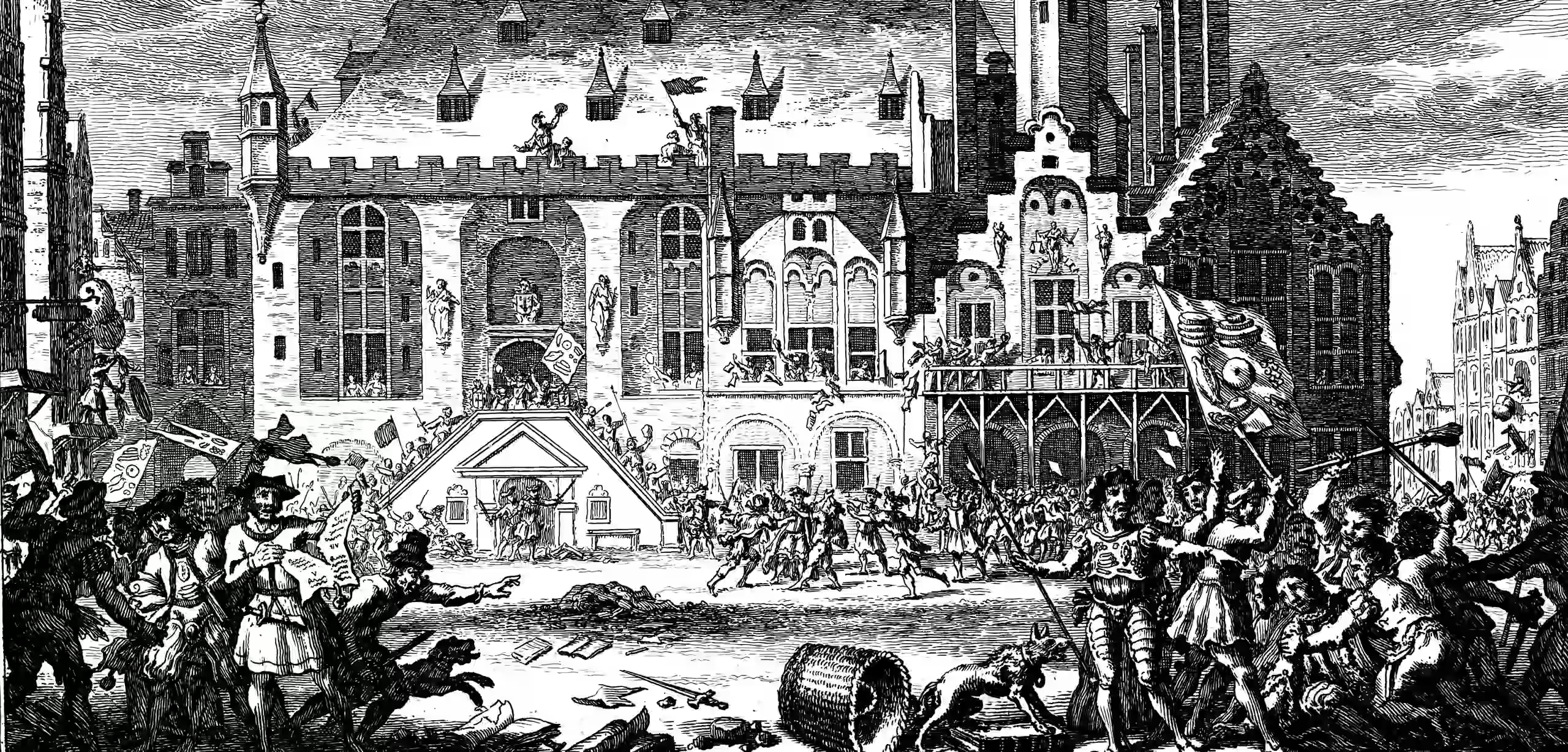
Context: I was a workplace delegate for the CSIRO Staff Association — which is a section of the CPSU, the public-service mega-union — at Data61, CSIRO’s digital research division, during a stretch when Data61 was being systematically under-resourced. This is a guide to being a member or delegate in a professional-staff union in Australia, not a guide to unionism in the abstract. People should write guides for meatpackers or wharvies, and for other professional unions too. And they have.
After some struggle I realised that write-ups of the ins and outs of unionising seemed to be kinda sparse in my cohort (i.e. nerds, professionals) and I figured it would be good to speak up about it.
My union experience was actually kinda great. This is a pleasing realisation, because if I had reasoned from the ambient opinions about unions, I might have thought that a union membership card was something I would pick up in an unlabelled brown paper bag from behind the counter of a vendor of ill repute.
Instead: free merch, deep intel on what is going on, a chance to speak truth to power, and the satisfaction of having helped to make things better for colleagues.
There are downsides too, ofc. Read on for the dirty.
1 Australian context
Union density in Australia is about 13.1% of employees as of August 2024 — up from 12.5% in 2022, the first recorded increase since 2011. Over the longer term the trend is down: in 1992, density was 40%. That is to say, the movement has been dying for three decades, and recently it, uh, stopped dying. Something interesting is happening at the margin, starting from a low base.
Inside those averages, professionals are overrepresented (around 20% density) and education-and-training workers more so (27%). So if you are a white-collar knowledge worker reading this, you experimenting with unionism is not unusual for your industry. There are plenty of us already, just not looking prominently Bolshie means we are just invisible.
The Australian union system is unusual in a few ways.
Enterprise bargaining is the central mechanism for negotiating conditions. Pay and conditions for most workplaces are set by an enterprise agreement negotiated between the employer and a bargaining representative — usually the union — at the level of the single workplace or company. Since the Fair Work Act 2009, this is how a modern Australian pay rise gets made. Our union’s main job, most of the time, is to negotiate this instrument.
Protected industrial action is only legal during bargaining for a new agreement, and only after a secret ballot via the Fair Work Commission, and only with three working days’ notice (for most workplaces). Striking in solidarity with another workplace is not protected, which is to say, it is effectively illegal. So, don’t be bringing to mind militant historical or European unionism when you think about the modern Australian version.1
Most big unions affiliate to the ALP. “Affiliate” means something specific: the union’s President and Secretary sign a pledge to the Labor platform, pay a per-member affiliation fee, and the union’s members are thereby entitled to 50% of delegate positions at Labor state and national conferences. The ACTU itself does not affiliate — it is a peak body — but most of its largest member unions do. In practice, this means some fraction of our dues is helping to elect a particular political party, and that the union’s political stances will be calibrated against not upsetting Labor. We can think this is fine or not fine. I am personally not a fan, since I think it sets up bad institutional incentives.
2 Flaws
2.1 Incumbency bias
This one is obvious when you think about it. Unions are disproportionately composed of, and run by, indefinite-tenure staff. The consequences cascade.
In enterprise bargaining, the people who turn up to the member meetings, write submissions, and stress-test the employer’s offer are overwhelmingly indefinite staff. They know how it works because they have been through a round before. The fixed-term, casual, and labour-hire workforce — which in research is often the majority — frequently doesn’t know bargaining is happening, or doesn’t know they can participate, or rationally does not invest in a process whose outputs they may not be around to enjoy. So the agreement gets tuned for the people in the room.
A large fraction of delegate time goes into redundancy negotiation. That is not a criticism of delegates — redundancies are harrowing and it is hard to argue that being present is not helping people in a real way. It also sketches the contours of the service the union tends to provide: a union that spends most of its crisis capacity defending tenured jobs is, implicitly, a service for people who have tenured jobs to defend.
For young workers, on a fixed-term contract, or otherwise outside the incumbent class, the union can feel irrelevant by default. Still, I reckon, worth joining. Just go in expecting to need to push for your own interests.
2.2 Operational conservatism
Unions per default do not take the operational needs of the employer seriously, or at least make ambit claims that imply they don’t. “I know the budget was cut by 15% but we want a 15% pay rise with no redundancies” will … never work? Nor will “always favour incumbent staff and also hire all the new skills we need.”
Maybe this is just me running into someone else’s negotiation style, but for me it would be more credible if we could go into negotiations with a more flexible, problem-solving mindset, instead of “they start cruelly low, we start impossibly high and then meet in the middle.” Or maybe this is how organizations have to negotiate because complicated platforms are hard to vote on.
This is not what they are for, I suppose, but the consequences show up in the agreement. In bargaining I have watched clauses land which would, I could see, make some internal workflow I care about more cumbersome. A classic example: by making it hard to sack people and hard to hire on short-term contracts, the union starves the organisation of the ability to experiment with short-term contracts for new skills and capabilities.
OTOH, by permitting short-term contracts, the organization would have license to recruit transient staff who would never join the union (bad for the union) and not negotiate for better conditions (bad for the union’s members).
A related failure: unions rarely favour creative or radical approaches. “We got this last round, let’s get a bit more of it this round” is the default. Arguments for novel structures — more flexible project-based teams, different modes of career progression, profit-sharing arrangements for commercialisable work — tend to fall outside the union’s Overton window. Part of this is presumably institutional memory (those structures have been used as thin ends of anti-worker wedges before). Part of it is organisational inertia.
For the kind of person who likes working on hard interesting problems inside a functional organisation, the union’s default policy stance can feel like being in a 1950s time tunnel, aimed at a very different, less dynamic world of work. Again, this is not what the union is for, but it is a consequence of the institutional setup.
How to solve for this? I reckon it’s worthwhile at least turning up and having a chance to push for good outcomes, without hoping for a complete solution from this alone.
Complete solutions would be worker co-ops, or a more radical political economy, or a different industrial-relations framework. Work towards those too.
2.3 The professional-organiser problem
Big unions employ professional organisers and officials. These are often good, dedicated people. They are also incumbents in their own sense — they have career paths, personal influence, factional alliances, and a durable stake in the union’s continuing to be run the way it has been run. In the worst cases this produces performative, communications-hoarding, process-heavy unionism that does not scale with the membership’s engagement.
The tell I watch for is the communications architecture. If the union does not host a chat channel where members can talk to each other — if all communication is union-to-member broadcast from the officials, with no lateral member-to-member channel — then that is a union whose professionals are more comfortable talking to members than enabling members to talk to one another. We can draw our own conclusions about why. My guess: an engaged, talkative membership is harder to steer.
I don’t think this is malice. I think it’s an equilibrium that is comfortable for professional staff who are only shallowly engaged with any given workplace’s problems, and that persists because nobody with the power to change it has much incentive to.
2.4 The enervating Fair Work settlement
The Fair Work Act gives Australian workers a floor of rights (minimum wages, leave, unfair dismissal protection, an enterprise-level bargaining mechanism) that is better than nothing. It also gives Australian unions a narrow, procedural, Commission-mediated menu of actions they can choose from. Protected action is protected only within tightly drawn conditions. Pattern bargaining across an industry is largely forbidden. Sympathy strikes are forbidden. The whole apparatus assumes that industrial conflict should be rare, procedural, and bounded.
This produces an enervated unionism. The union rarely needs to mobilise its membership at scale — the Commission is right there, the processes are what they are, and the union’s comparative advantage is procedural expertise rather than mass pressure. Compared to what one reads of unionism in, say, the US or continental Europe, the Australian version can feel strangely administrative. I find this both a relief (nobody is getting arrested) and a limitation (nobody is winning very much, either).
3 Why it’s worth it anyway
Given all the above, why did I sign up as a delegate, and why would I do it again? Because the leverage is huge. Being a delegate got me:
Inside gossip. The delegates’ meetings are where one learns what management is telling the union, which is often a truer signal than what management is telling staff. One sees drafts of redundancy proposals before they become announcements. One hears which divisions are being quietly wound down. Going the other way, the delegate carries back useful information about the workforce that the management chain on its own would not have heard.
The more underrated form of this, IMO, is lateral gossip — what peers know about each other that a hierarchical organisation aggressively filters out. Our formal view of colleagues in other teams is mediated almost entirely by those teams’ managers, who have career incentives to present their units as competent, well-run, and indispensable. The union is one of the few structures in a big organisation where frontline staff from different teams compare notes, and discover: which empire-building manager is winning headcount they don’t have work for, which team is quietly drowning, which senior technical lead is the bottleneck nobody can work around, which department’s nominal stars are coasting, which quiet group does the good work that never shows up in the monthly report. This stuff matters for a lot of mid-career decisions — internal transfers, whether a cross-team dependency is safe to rely on, which up-chain promises are worth trusting — and in an excessively hierarchical organisation almost none of it is available through any other channel. People seriously underestimate how much of their picture of their workplace has been composed for them by interested parties. The union cuts across that.
Strong relationships with colleagues across silos. Research organisations partition into teams that rarely talk to each other, and that compete for resources. The union is one of very few structures where a data scientist talks to a comms officer talks to a facilities manager as peers with a shared interest. This defangs a lot of internal resource competition simply by putting faces on the “other” side of it. The employer benefits from this too, even if they rarely notice: a less siloed workforce wastes less energy on internal turf wars.
Esprit de corps. Not nothing. Knowing that one has a dozen colleagues whose numbers are in one’s phone, and who will pick up, is a psychic resource in a way that is hard to describe until one has had it.
A widened range of sayable things at work. Delegates, by convention and by the adverse-action provisions of the Fair Work Act, have more protection for speaking publicly about workplace issues than ordinary staff do.2 We can say things a rank-and-file employee would be nervous to say, because we are saying them in our delegate capacity. This is not absolute — we can still be sacked for many things — but it widens the range of sayable things considerably. I used this a lot.
A direct line to powerful people when it mattered. At bargaining time, at redundancy time, at restructure time, delegates are in the room with the CEO, or the DG, or their direct deputies. One gets to negotiate with the people actually making the decisions. For a mid-career professional this is an unusual amount of face time with senior leadership, and the skills one builds — reading the room, finding the pressure points, knowing when to escalate — are portable.
Friends. I left the delegate role with more friends at CSIRO than I had before I took it. I don’t know a better return on my time.
4 A second centre of power
Most of the above is about what the delegate gets. The less obvious side is what the employer gets from having a functioning union on the premises. IMO a sensible leadership team treats the union as a cheap source of information and a cheap source of accountability that would otherwise be unavailable to it, which is the core of what having a second centre of power inside an organisation buys you.
Every formal complaints mechanism I have heard of routes upward through the chain of command. Which fails at the kind of case that matters most: when the problem is the chain of command. A staff member being ground down by their manager has almost nowhere to go internally — the next rung up is the bully’s mate, or someone institutionally invested in not seeing the bully as a problem. The union is a parallel chain that does not route through the bully. At least, not that bully. A well-run HR function treats this as a useful signal, because it surfaces problems the formal channel would have swallowed. A badly run one resents it. The ones that resent it tend, in my experience, to be the ones whose formal channel is broken in ways they would rather not admit.
Risk identification. Frontline staff know things that never make it onto a dashboard: project-failure signals, mis-scoped deliverables, customer-abuse patterns, strategies that will not survive contact with reality. A lot of this information is uncomfortable, which is precisely why it gets filtered out as it moves upward through layers of people whose performance reviews depend on appearing to have things in hand. The union is one channel by which those signals can bypass the incentive structures that suppress bad news going up the chain. I think that organization could benefit from this? But what I have noticed is that they treat it as a threat.
A commitment device. An enterprise agreement, together with an organised workforce that will notice breaches of it, is a way for senior leadership to credibly commit to things. Promises management would like to make but cannot otherwise guarantee — about workload, about career paths, about fair treatment of a category of worker — become more durable when backed by a bargaining process and a Union that will kick up a stink if the promises are broken. In principle, the employer gets a more motivated, lower-turnover workforce in exchange for being bound to its own stated intentions.
This is not to pretend away structural conflict. Interests do diverge — about wages, about job security, and above all, who carries the risk when things fail. The bargaining apparatus is built around those divergences. But most decisions, at least in my workplaces, most of the time, do not need to be zero-sum wars. Some zero-sum fights I was involved in were made to be zero-sum to keep people busy and distracted, and to stop them from collaboratively solving the real problem. When a bad manager stokes conflict to distract attention from their own failings, this is a power play, not an inevitable state of affairs or rule of nature.
Neither “side” is a monolith. “Workers” and “employers” are each coalitions — junior and senior staff, contractors and indefinite, technical and administrative; shareholders, executives, line managers, finance, operations — with partially overlapping and partially competing interests. Cross-line alliances — this technical team and the CTO, this cohort of staff and the CFO’s cost-containment agenda — are common and often stable. The two-team framing is convenient shorthand at best.
Leaning on the adversarial frame as the default identity of unionism — worker-vs-boss as our core brand — is great for recruiting — people love a fight with the Other. But it has costs: it alienates the moderates on both sides, and leaves win-wins on the table that would otherwise have been obvious.
It seems most executive teams don’t want union pushback. IMO they should want all the union engagement they can get. A second centre of power inside a dysfunctional organization can be one of the few ways management gets the information and accountability needed to stop making predictable, avoidable mistakes — which is a case of the institutional alignment problem. The union, or at least many unions I have been involved with, can be a flawed exemplar of that second centre: too procedural, too political, too disengaged, for all the reasons I listed above. But those flaws are not, mostly, irreducible features of unionism. They are habits that unions can fall into, and which we can change by joining the damn union and making it work better.
Ultimately, the union is us. If we want a second centre of power in our organisation that is not captured, not incumbency-biased, and not hoarding communications, the mechanism by which it comes to exist is: we join, we show up, we pay 0.7% of our salary, we invest our time and sweat equity in making everything else better. The price of admission is unusually low.
5 Advice I wish I had on day one
A few things I had to work out the hard way.
Turn up. A startling fraction of the influence in the delegate body accrues simply to the people who turn up to every meeting. This is unglamorous and correct. Showing up is 80% of the job. If there are literally too many meetings to attend, ramp it back. If the union insists on stupid held-over structures (e.g. place-based organising for an online organisation with distributed teams, looking at you CSIRO Staff Association) we could make it a project to try to modernise.
Ask for the bargaining log of claims early. Every round of enterprise bargaining starts with a list of things the union is asking for. If you are not on the bargaining committee you may not see it until it is near-final. Ask for it. If there are claims we care about, we have to fight for them early in the process, not at the end.
Cultivate union communications the union staff cannot control. Ideally you trust your organiser (for the record, I always trusted mine). But baking too much control into the union staff’s roles sets up bad incentives for them to hoard power just like the bosses. If the union doesn’t run a members’ chat, start a group chat among the delegates you trust.
Learn the instrument. So easy these days that there is no excuse. Load the current enterprise agreement into an LLM. The last one too. Also, Part 2-4 of the Fair Work Act. Ask questions. Read specific passages. Learn the stupid terms of art. We become much more useful to our colleagues the moment we can answer basic questions about the instrument instead of referring them upward.
Practise communication skills. Delegate work is the best-calibrated training environment I have found for the workplace-communication skills that white-collar work otherwise hides from us until we are mid-career and already expected to have them: writing a clear update for members, chairing a meeting where people disagree and we need a decision at the end of it, negotiating with a senior executive who has lawyers (we don’t), delivering hard news to a colleague, pushing back on a bad idea without burning the relationship. The stakes are high enough that sloppiness has consequences, and low enough that we get to try again next meeting. Take the opportunity.
Do not let this become your whole life, or even your whole job. Union work is high-leverage precisely because the baseline engagement of everybody else is so low. Which means there is infinite demand for your time. Decide in advance what fraction of your working week you will spend on it, and stick to it. Extension projects are good, but don’t pick too many.
Recruit more delegates. The more delegates we have, the more influence we have, and the less work each delegate has to do. Don’t solve everything yourself; solve one thing and use that as a recruiting pitch for the next delegate. Showing people they can make life better is hugely encouraging.
We get so much love for doing this. People, mostly, value and appreciate the work of delegates. I got so much respect from my colleagues when I’d shown up for a tough time, but they would make sure the line manager was not around first. Then the line manager would also thank me, when their direct reports were not around. Double thanks!
6 Unfinished business
Things I wanted to get to and didn’t, in case some other delegate is reading this and looking for a project.
Modernising workplace democracy with the civic-tech stack. The CSIRO Staff Association still runs on place-based organising for a workforce that is distributed and largely online. The mechanisms surveyed in that notebook — bridging-based aggregation (Polis, Community Notes), AI-mediated deliberation, participatory budgeting — are exactly the tools a union ought to be piloting on itself. A union is one of the few institutions inside a firm with the standing to run them, and one of the few with a membership big and engaged enough to generate the signal. Nobody is doing this seriously in the Australian professional-union space, as far as I can tell.
Bringing the fixed-term, casual, and labour-hire workforce into bargaining. See the incumbency-bias section. I had ideas, I ran out of road.
Member-to-member communications infrastructure that the officials don’t control. I started this and didn’t finish it. It is harder than it looks, because the people most willing to spin up a chat are also the people most likely to make it weird.
Working out whether labour unions have any leverage left as the economics of cognitive automation shifts under us. The whole bargaining apparatus assumes that the workforce is hard to replace at short notice. If a meaningful slice of professional-staff tasks becomes a thing the employer can buy on an inference budget, the strike threat — already attenuated by the Fair Work Act — gets thinner. My guess is that unions do still have leverage for now, partly because the substitution is patchier than the headlines suggest and partly because the political-and-legitimacy costs of replacing organised workers with bots are still real. But that window is now, plus not much runway: anything we want enshrined in an enterprise agreement — clauses about AI tooling, retraining commitments, displacement protections, transparency on automation pilots — has to land in the next round or two, while the threat of collective action is still credibly priced into management’s calculations.
7 If we were starting from scratch
A sceptical reader will have noticed that almost everything in this post is a second-best argument. The union is a patch on a firm shape that has employees and shareholders on opposing sides of an ownership boundary, with managers in between. A lot of what the union does — surfacing risks, piercing silos, keeping managers accountable, sometimes even committing the enterprise to its stated intentions — is only necessary because the firm is designed the way it is.
Other shapes are possible. Let me get galaxy-brained for a second: Worker-owned firms, consumer cooperatives, and various flavours of co-determination redistribute the ownership boundary and fold the “second centre of power” into the first. I have written separately about how one might divide equity in a firm being built along those lines. More broadly, this sits inside the frame of institutional alignment: any institution we build is, in effect, a trained system whose incentives and reporting structures have to be tuned for the work we want out of it, and most organisations have simply never been tuned for the work of collectively caring for the people inside them.
A ground-up redesign is not on the menu for most employees of most organisations. But the frame is useful for explaining why even a flawed union is high-leverage: unions are one of the viable ways to retrofit decent communications into an ossified organization. If we could start over, we might build that in at the foundation. We mostly can’t, so we patch.
8 Resources
Background and statistics
- ABS Trade Union Membership, August 2024 — primary source for density figures.
- RBA RDP 2019-02: Is Declining Union Membership Contributing to Low Wages Growth? — careful empirical work on the wage effects of union decline.
The legal instruments
- Fair Work Ombudsman: Enterprise agreements and bargaining
- Fair Work Commission: Industrial action
- Fair Work Act 2009 (text)
Peak bodies and some relevant unions
- Australian Council of Trade Unions (ACTU)
- CPSU (PSU Group) — federal public sector
- CSIRO Staff Association — a section of the CPSU; my own alma mater
- NTEU — tertiary education
- Professionals Australia — engineers, scientists, managers
Footnotes
The history is pretty cool though, esp. Paddy Troy.↩︎
Strictly, the Fair Work Act’s general protections (Part 3-1) are what actually do the legal work; the constitutional “implied freedom of political communication” is a much narrower doctrine that rarely maps cleanly onto workplace speech. Conflating the two is sloppy but a useful shorthand for the lived experience of being a delegate.↩︎