How to communicate
with humans
2019-04-02 — 2026-02-09
Wherein Assertive, Non-Violent, and Decoupled Talk Is Catalogued; Ask-Versus-Guess Norms Are Contrasted, and Crunch-Mode Costs Are Estimated as Leave and Recovery After Prolonged Sprints.
Communicating in the highly artificial situations of modern life is a set of skills. They’re crucial, and we’re too rarely taught them. Worse, we systematically fail to realize we lack them.
Here are some resources I use to work on these skills. I also analyse these in a broader social context—for example, speech standards.
1 Assertive communication
The classic (and cheap) Assertiveness at work (Back, Back, and Bates 1991) is short, clear, and full of practical exercises. I buy copies of this in bulk and give them to friends facing workplace friction. It’s excellent; I can’t recommend it highly enough. Not least because the downside risk of a $5 second-hand book is low. Key quote:
We use the word ‘assertion’ … to refer to behaviour that involves:
- Standing up for your own rights in such a way that you do not violate another person’s rights
- Expressing your needs, wants, opinions, feelings and beliefs in direct, honest and appropriate ways
We will demonstrate this with an example. Suppose your manager asked you to complete some additional work by the end of the month. You are the best person to do the work, but your time is already fully committed to other work. An assertive response in this situation would be:
“I appreciate that you would like this work completed by the end of the month. However, I don’t see that I can fit it in with my workload as it is at present, so can we discuss it?”
So assertiveness is based on the beliefs that in any situation:
- You have needs to be met
- The other people involved have needs to be met
- You have rights; so do others
- You have something to contribute; so do others
The aim of assertive behaviour is to satisfy the needs and wants of both parties involved in the situation.
This is one of those things that isn’t rocket science when we read it back to ourselves, but in my experience it’s taught poorly pretty much everywhere.
I really like their framing. They discuss assertive speech as a standard of communication that we can mutually agree upon, which, if we all accede to, will lower overall stress. It is a proposal for an emotional lingua franca.
Occasionally I get pushback from people who don’t like the assertiveness ideal. What about people raised in a culture where they’re never allowed to assert their own needs? What about people who have particular communication challenges that make it hard to be assertive? What about toxic environments where assertiveness is punished? What about minorities who are punished for assertiveness?
Yes, fair enough. Some people face barriers that make it hard to express themselves, whether internal or external. I don’t want to claim that anyone is a bad person for not being assertive. I do, however, think it’s a good ideal, and the underlying concepts are useful for analysis.
- Naming communication styles is a good idea: it helps us remember that there are communication styles, and what each style implies.
- The authors’ taxonomy—assertive, aggressive, and passive-aggressive communication—gives us a useful vocabulary for discussing different communicative moves.
- The assertive communication style is a good lingua franca, but that doesn’t mean it’s the only language anyone should speak. As with any cross-cultural communication situation, if other dialects are in play we can negotiate to speak them too; learning dialects can sometimes be a worthwhile price to pay.
Not read yet:
Negotiation trainer Misha Glouberman is eloquent on the Dave McRaney podcast: How to have better conversations with loved ones (and just about anyone) about difficult topics (and just about anything). His approach seems to build on books like Stone and Heen (2011) and Ury and Fisher (2012).
2 On crunch mode
I was recently asked:
In a high-urgency environment […] ‘moving fast’ often conflicts with building an inclusive and psychologically safe culture. How do you personally feel about this trade-off? When, if ever, is it acceptable to sacrifice team well-being or good processes for the sake of speed?
My response:
It’s myopically acceptable when it is empirically supported as an optimal move for a given project. On the one hand, there is much empirical evidence that in the long run psychological safety is upstream of high-performing teams (Kim, Lee, and Connerton 2020; Edmondson 1999), so our priors should favour psychologically safe environments, in some sense, by default, and update when there is empirical counter-evidence, rather than a single high-status individual unilaterally declaring that they can, e.g., play dominance games in the absence of credible evidence that it will benefit the project.
We can have both, by which I mean a psychologically safe, consensual negotiation of risky work practices. On previous crunch-mode projects, I negotiated unsustainable, risky psychological environments, relying on prior trust. In the best cases I did this by estimating the organizational debt incurred. For example, on a previous team, it seemed to take about 3 months to recover relationally plus about 2 weeks of leave per person after 3 months of sprint-mode (10-hour days, 7-day weeks, playing by Crocker’s Rules for all comms.). Generally, people in such teams are not able to resume crunch mode for quite a while. A sprint that fits that description is ex ante worth it if the expected value of sprint-mode is greater than the cost of effectively dissolving that team for about 3 months and suffering from the reduced capacity from the breaks all participants need.
I emphasize that this kind of stunt was feasible for this team because we had already negotiated a high-trust relationship in which we could make this call, and a clear-eyed evaluation of the counterfactual value; I don’t think we get to skip either of those steps.
Imagine an organization that constantly required crunch-mode unsustainable practices and did not provide evidence that the associated burn-down of organizational and human capital was worthwhile, nor negotiated enough prior trust to engage in crunch mode. What reason would we have to suppose that such an organization was either ethical or aligned with actually delivering impact? If we claimed to be interested in aligning algorithms, would we also face a credibility problem if we used a misaligned mechanism to research alignment? Ultimately, an environment that has an appetite for baseless imposition of psychological risk might select for individuals who enjoy imposing psychologically unhealthy conditions on staff for personal reasons, rather than relying on evidence and consent. It would filter out high-value team members who need a higher degree of psychological safety and are nonetheless worth keeping because of their extreme value-add.
I’m aware that some people would mention Tesla or SpaceX as examples of psychologically unsafe, high-performing organizations. I’m not an expert in the internals of such organizations. I agree that in themselves they are high performing. OTOH, I’ve met enough burned-out Tesla alumni who have gone on to behave dysfunctionally and counterproductively in their subsequent projects that I suspect these organizations are imposing a burden upon their field of burned-out “hard-core” engineers who think they can recreate Tesla and cannot.
3 Non-aggressive communication
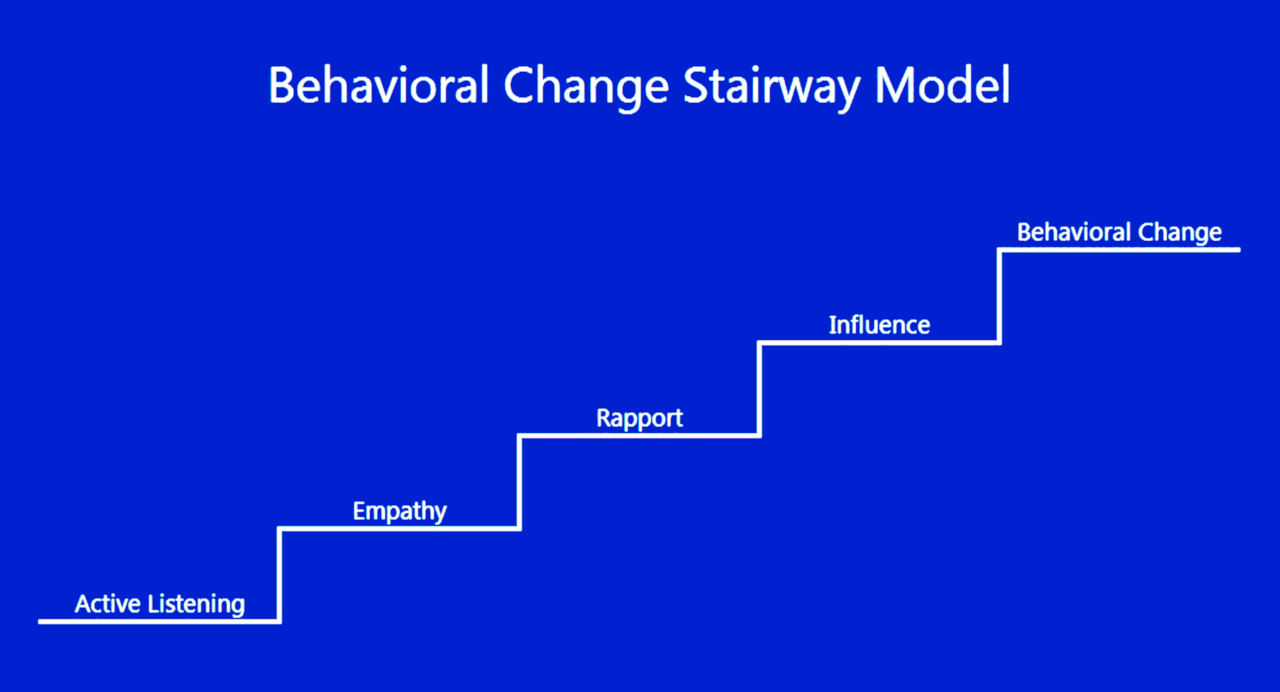
Dave Bailey summarizes Marshall B. Rosenberg’s Non-Violent Communication, whose key advice is similar. It looks similar to the FBI Behavioral Change Stairway Model, (Vecchi, Van Hasseltb, and Romano 2005) which they use for hostage negotiations and suicide threats, so it’s literally a battle-tested system in that regard.
Deep canvassing is probably in this category, (Broockman and Kalla 2016). There’s a convenient Dave McRaney podcast on this theme.
4 Principle of charity
Ethics Explainer: The principle of charity
The principle of charity suggests we should try to understand ideas before criticising them.
Arguments should aim at finding the truth, not winning the fight.

Nate Soares, “Assuming Positive Intent”
I believe that the ability to expect that conversation partners are well-intentioned by default is a public good. An extremely valuable public good. When criticism turns to attacking the intentions of others, I perceive that to be burning the commons.
Obviously, some people in the world don’t want positive things, and we need to be aware of that. However, importing the communicative norms of, say, political Twitter or some other such weaponised battlefield into intimate communication will kill trust before it’s born.
I personally love this. But I need to point out that we can’t do it unilaterally. Maintaining trust in positive intent requires us to successfully playing an iterative conversation game together. Assuming positive intent is more or less playing “cooperate first”; the move the other player makes next is what determines whether we can keep cooperating or whether we need to switch to a more defensive strategy.
5 Negotiating communicative styles
Trust dancing is a fun term coined by Malcolm Ocean.
The term here is supposed to highlight a meta-protocol for negotiating the actual communicative protocol we will use, rather than assuming that everyone can work with whatever system we’re used to. In practice, successful multicultural societies seem good at this.
This resonates with me because I recently had a falling out with a flatmate who found my usual conversational gambits triggering — what I took to be active listening and nonviolent communication came across as manipulative and/or patronising to her. How do we move a discussion forward in circumstances like that?
I find Piper Harron’s post Why I Do Not Talk About Math troubling. Is this a parable about failing to negotiate a satisfactory communicative style despite everyone’s best efforts?
Nobody was mean to me, nobody consciously laughed at me. There’s just a way that mathematicians have been socialized (I guess?!) to interact with each other that I find oppressive. If you have never had someone mansplain or whitesplain things to you, it may be hard for you to understand what I’m going to describe.
I find this hard, but I want to understand the example.
For me, the norms in mathematics are kinda fun. I find tone-deaf, argumentative environments pretty homely most days. If I don’t enjoy that on a particular day, I can usually negotiate something different. Some people feel they don’t have the scope to do that, and for all I know they’re right. How do we fix that?1
5.1 Asking
It’s an important norm, and it’s worth making explicit. See ‘Askers’ vs. ‘Guessers’, which credits Metafilter user tangerine:
This is a classic case of Ask Culture meets Guess Culture. In some families, you grow up with the expectation that it’s OK to ask for anything at all, but you gotta realize you might get no for an answer. This is Ask Culture.
In Guess Culture, you avoid putting a request into words unless you’re pretty sure the answer will be yes. Guess Culture depends on a tight net of shared expectations. A key skill is putting out delicate feelers. If you do this with enough subtlety, you won’t even have to make the request directly; you’ll get an offer. Even then, the offer may be genuine or pro forma; it takes yet more skill and delicacy to discern whether you should accept.
A recent podcast discussion of this was on Spencer Greenberg’s Guess culture vs. ask culture (with Will Eden and Sam Rosen). I take issue with that podcast, though — I felt it weak-manned the case for asking. The pro-asking guest seemed to describe asking culture as cultivating an expectation of tendentious, provocative questions in situations with shaky psychological safety. For me, the central idea of asking is that an efficient way of negotiating psychological safety is to ask about things directly, even those that seem taboo, and to take the answers at face value. Also, when in doubt, we can clarify ambiguous needs and take people’s explanations at face value. This is much simpler and, to my mind, less exclusionary than, for example, communication systems that require high degrees of in-group tacit knowledge.
Asking can be taken to excess — asking someone about a recent traumatic experience isn’t being an Asker; it’s being tactless in a context where that kind of asking isn’t safe. However, in day-to-day life, I think it’s the way to go. I feel better when people assume less about me, and when I assume less about others. This means that, when I’m talking to someone I don’t know, I can rely less on stereotypes and prejudice and more on taking people as they are, rather than reducing them to a caricature of their group. Guessing culture is for closed in-groups, psychotherapy sessions, social workers amongst fraught populations, and so on. That is, I hew close to Jonathan Chait’s opinion, Ask, Don’t Guess:
Guessers are wrong, and Askers are right. Asking is how you actually determine what the Asker wants and the giver is willing to receive. Guessing culture is a recipe for frustration.
What’s more, Guessers, who are usually trying to be nice and are holding themselves to a higher level of politeness, ruin things for the rest of us. I’m not a super hospitable guy, but I frequently find myself offering things to other people that I’d like them to take—say, leave their kids at my house to play with my kids—but they refuse to take because they think I’m a Guesser, offering hospitality I secretly hope will be turned down. Guessers are what forces people with poor social discernment, like me, to regard all kinds of interactions as a minefield of awkwardness.
5.2 Crocker’s rules
Here’s a name for a norm I sometimes notice and enjoy in academia: Crocker’s rules.
Declaring yourself to be operating by “Crocker’s Rules” means that other people are allowed to optimise their messages for information, not for being nice to you. Crocker’s Rules means that you have accepted full responsibility for the operation of your own mind — if you’re offended, it’s your fault. Anyone is allowed to call you a moron and claim to be doing you a favour. (Which, in point of fact, they would be. One of the big problems with this culture is that everyone’s afraid to tell you you’re wrong, or they think they have to dance around it.) Two people using Crocker’s Rules should be able to communicate all relevant information in the minimum amount of time, without paraphrasing or social formatting. Obviously, don’t declare yourself to be operating by Crocker’s Rules unless you have that kind of mental discipline.
Note that Crocker’s Rules does not mean you can insult people; it means that other people don’t have to worry about whether they are insulting you. Crocker’s Rules are a discipline, not a privilege. Furthermore, taking advantage of Crocker’s Rules does not imply reciprocity. How could it? Crocker’s Rules are something you do for yourself, to maximize information received — not something you grit your teeth over and do as a favour.
By framing these as a consensual communication strategy, we defuse one problem with brusque communication — different people read it differently; for some it’s aggression, for others it’s respect for another person’s time.
I’m part of many academic email exchanges that are “cleanskin” Crocker exchanges, in that academics are just being their tactless selves, and I find them effective. Some people might find those exchanges aggressive.
6 Decoupling
A term for dealing with arguments based on their content rather than their context. For me, this is something we need to do to make progress. I accept that decoupling must be accomplished rather than assumed.
Much has been written on this theme. For an example, see: A Deep Dive into the Harris-Klein Controversy, and for some background, see Decoupling revisited.
Question: Is decoupling possible within conflict-theoretic worldviews?
Helpful insight: Decoupling as a Moral Decision.
The Motte is a miniature subreddit spinoff that attempts to be all-decoupling, all the time. It is hard work, especially in an open public sphere where people are constantly coming in and messing it up. It’s also kind of addictive.
7 Workplace in particular
See workplace habits.
8 As a manager
See managing.
9 Compliments
10 Consent
QiaochuYuan wrote the world’s bravest first tweet.
People use consent to mean (at least) two things: a tool, and the thing the tool is supposed to accomplish. I think we need different words for the two things, and suggest “consent” for the tool and “participation” for the thing it’s for.
Consent-as-a-tool means: explicit communication. Setting boundaries. Setting context. Here’s what I want and don’t want. Here’s what I’m up for and not up for. Much broader than sex: any time two or more people get together you can do some of this.
Consent-as-a-tool tries to establish shared meanings about the actions we might take together: what does it mean if I touch you this way? What does it mean if you touch me that way? Especially, it tries to establish which things mean “we’re still okay.”
We need to establish shared meanings explicitly like this, now, because much of the cultural architecture that used to establish them implicitly in the background, for past humans in small communities, is dead (shared religion, etc) and has been for awhile.
What consent-as-a-tool is trying to accomplish is “participation,” which means: feeling safe enough to play beautifully together. Cocreation of the moment in the moment. Mutual sovereignty. Not causing trauma. Again, much broader than sex: kink, improv, partner dancing, etc.
And now I have the language to say this: consent is not sufficient to cause participation. Consent doesn’t guarantee you’ll have a good time, and it doesn’t guarantee you won’t be traumatized.
I personally have consented to touching and being touched in ways that I did not like in retrospect. I didn’t know how to object. I wanted the person touching me to like me and to think I liked them. I conceptualize this as: I consented but wasn’t participating.
I also personally have done this to other people: gotten their consent but not their participation. It’s depressingly easy. I regret it and am trying to do better.
“Not participating” can be a lot of things: being too frozen in fear to say no. Being too wrapped up in a particular story about what’s going on to notice that there’s something you want to say no to. Being jerked around as a follow by a lead in a dance.
“Not participating” means your ability to cocreate the moment is being cut off by something—a habit of not standing up for yourself, trauma, wanting to keep someone else happy, explicit or implicit threats. All sorts of things.
“Not participating” can be as much about you as about the other person. It’s about how the two of you are interacting as a system. Much more complicated than consent violation.
Ex: I heard a story once about a woman who enthusiastically consented to sex, even or especially if she didn’t want it (I don’t remember why, maybe to keep people happy or get it over with or something). She consented but cut off her own participation. This story terrifies me.
And OTOH, people can be coerced into consent. That sucks. And in order to even say that, we need the distinction between consent and participation: if you were coerced into consenting, then you didn’t participate. (And I’m sorry.)
Some might prefer to say “if you were coerced into consent, then you didn’t really consent.” This is totally unworkable as an approach to consent-as-a-tool, and I’d rather talk about this sort of thing using participation.
If “really consenting” has to do with another person’s internal state and not what they communicate to me, then I can’t ever know if I have “real consent” without being able to read people’s minds. (This is something I periodically freak out about.) This won’t work.
Instead, let’s distinguish between “getting consent,” meaning having used the tool (explicit communication, setting context, setting boundaries), and “causing participation,” meaning the good stuff is happening and not the bad stuff. Dancing beautifully together.
Among other things, this distinction raises the question: what else besides consent is useful for causing participation? This is a deep rabbit hole. Participation is the entire problem of how to engage well with other people.
Thinking about it leads to hard and uncomfortable ethical, psychological, spiritual, and philosophical territory: what does it mean to want something? How can you even tell that you want something? What does it mean to manipulate someone? Etc.
Example: if you subscribe to something like Internal Family Systems’ framework that people have different parts that want different things, if Alice has a part that wants to have sex and another part that doesn’t want to have sex, does Alice want to have sex?
11 Intimately
See relationships
12 …with me
Here are my current communicative preferences, affordances, and commitments.
I’d like to work with people to learn true things: truth is good, it can be used to make the world better, and that in turn makes truths about it more beautiful. To that end, I invite your disagreement, criticism, and collaboration on knowledge, and, I guess, on life itself.
Disagreement is one of the hardest things to do in conversation. Here’s some background for communicating with me generally, especially about disagreement.
Native English speaker.
Obligate extrovert.
Generally interested in people and their wonderful weirdness and variety.
I attach a high value to curiosity, kindness, empathy, equity, truth, and respect for other humans, and do my best to model that, or at least fake it until I make it.
My preferences are valid. So are yours. Let’s negotiate.
My metamorphosis from guesser to asker is complete, and I’m having trouble remembering how guessers work.
Going by my history, many of my opinions are wrong, and I can be persuaded to change them, though it usually takes a few tries.
I try not to believe many things, but I assign high certainty to some—probably more than I’d prefer.
I do my best to welcome and learn from your criticism of my opinions. (If I know you well enough, I’m game to play by Crocker’s rules).
We don’t need to get it right the first time. I’m happy to have do-overs, and for either of us to revoke what we said last time.
I think every topic is open for discussion.
- I confess: not in every context.
- I have trouble with the context part.
I admit that we need to discuss things with care and compassion, because while disagreement is not violence, speech can sometimes be a form of violence. If you don’t agree, you probably don’t know anyone who has been in an abusive relationship, and you are blessed.
I believe an argument’s force is primarily dictated by its logical and observational content, not who makes it (which is not to say your identity doesn’t influence the observations you make, or the discussions we might have).
I start from the assumption of positive intent, and in particular…
I do my best to take your statements at face value rather than as memetic warfare, unless you make it clear you intend otherwise.
I might enjoy debating with you in a contrary, contentious fashion, in the Rational Style if you were game for that.
If you tell me that something will burn me, I’ll probably touch it.
I am ready to play stag before rabbit.
My weak suit is the silent treatment. If you freeze me out without explanation, I’ll have trouble assuming you mean well. A short explanation of what’s going on would be high value if you could manage it.
In short, I’m a stroppy, empathetic extrovert who aspires to the possibility of reasonable discussion, and who would probably like you if you have interesting opinions.
13 Incoming
DRMacIver on Norms of Excellence
Conflict is Not Abuse and The Courage to be Disliked were very useful in helping me resolve a bunch of my emotional issues around this earlier this year. The two relevant concepts, which pair very well together, are the idea of “Separation of Tasks” and “Overstating Harm”. In short:
- How others feel is not under your control. (Separation of Tasks)
- Causing someone discomfort is not causing them harm. (Overstating Harm)
Online comment moderation advice (I’d like this to be data-backed): A Pragmatic Approach To Thorny People Problems.
Ian Leslie, Ten causes of breakdown in communication. The top one is excellent: believing you have communicated.
Gaël Varoquaux on Technical maintenance discussions.
Ozy Brennan on covert contracts.
no hello is a handy webpage about why we shouldn’t start chats with “hey”.
See also personality tests; If I recall correctly, there’s some communicative stuff there.
Academic writing is not so much brusque as verbosely passive-aggressive. We don’t talk inside the ivory towers the same way we declaim from them, or at least my teams don’t.
Good conversations have lots of doorknobs
Givers think that conversations unfold as a series of invitations; takers think conversations unfold as a series of declarations. When giver meets giver or taker meets taker, all is well. When giver meets taker, however, giver gives, taker takes, and giver gets resentful (“Why won’t he ask me a single question?”) while taker has a lovely time (“She must really think I’m interesting!”) or gets annoyed (“My job is so boring, why does she keep asking me about it?”).
It’s easy to assume that givers are virtuous and takers are villainous, but that’s giver propaganda. Conversations, like improv scenes, start to sink if they sit still. Takers can paddle for both sides, relieving their partners of the duty to generate the next thing.
Jeff Guenther:
8 really vulnerable questions to ask your partner that will deepen your connection.
- What was your first impression of me, and how has it changed since we’ve been together?
- What is something you love about our relationship, and what is something you think we could work on?
- Can you share a moment in our relationship when you felt especially close or connected to me? What made that moment special?
- What is one thing you wish I understood better about you, or something you’ve hesitated to share with me?
- How do you feel about the balance between giving and receiving in our relationship? Are there areas where you’d like to see more reciprocity?
- What’s a fear or concern you have about our future together? How can we address it as a team?
- Can you tell me about a time when you felt truly supported or understood by me? What made you feel that way?
- What is your favourite memory of us, and what do you hope for our future together?
14 References
Footnotes
NB: I’m not qualified to assess Harron’s research for novelty, but I can say her science communication is seriously innovative and top-notch; it would have been a loss to the field if she had given up. See her thesis for wonderfully clear explanations of deep algebraic weirdness that most people would find inscrutable.↩︎