Bikes
Especially bikes where I live, which means Melbourne at the moment
2014-11-10 — 2026-06-07
In Which a Cost Comparison of Urban Cycling Against Car Ownership Is Conducted, a Net Annual Saving of Some AUD9,500 Being Calculated When Travel Time Is Counted as Cardio Exercise.
1 Why I bike
tl;dr Riding, compared with driving a car, makes me richer and happier. YMMV.
I ride to work, and in fact most places.1 This is a good deal. Let me run the numbers.
My bike costs about AUD500 a year in maintenance, maybe up to AUD1000 if I include an amortized replacement cost.
Owning a small car costs about AUD6200 per year plus about AUD0.16 per km driven, plus parking fees. For my modest commuting needs, the fuel costs would be something like AUD500 at that price. Parking where I work is astronomically expensive and I won’t include it here because that would bias the numbers against cars too much.
But wait! The decisive cost for me when driving a car is time. By riding everywhere I log about 2–6 hours of cardio every week (call it 3 hours), and generally feel great. If I drove in Sydney traffic instead, I might save some (but not much) transit time, but that time would be dead — doing something I don’t enjoy instead of an activity I both enjoy and need. I would arrive at work sleepy, and I would still want to do the missed cardio so I could feel alive. Realistically I’d save maybe an hour of travel time but spend three more hours in the gym — a net loss of two hours every week from my brief life, not even counting that gym cardio is joyless compared with doing a real activity in the world. Assuming median Australian wages, the value of that lost time is about AUD4000 annually. Thus, my choice to ride a bike is worth around AUD9500 to me per year, compared to driving a car — that’s about AUD26 per day.
That’s before I factor in the vitamin D and sleep-regulation benefits of being outdoors, the sense of wellbeing that comes from moving my body, and — yes — the tight buns. Let’s assume that if we lump those positives together with some negatives — the increased risk of injury in traffic, say — they’re a wash. Then we are done. Riding a bike is worth about AUD26 a day to me, paid out in the coin of avoided cost and happiness. Separately — and not included in the AUD26/day above, to avoid double-counting — the ~3 hours/week of cardio is the highest-value line item in my healthspan ledger.
2 Users’ guide
The collected jwz bicycle wisdom is one guide to no-bullshit biking. Top tips include
“City bikes” and “road bikes” are designed for some Jetsons-slick hypothetical future city that I’ve never seen. Or maybe for the bike paths in Los Altos or something. Here in real cities, roads are shit, and if you want your wheels and tires to survive curbs and potholes, you need a hybrid. They’re a little heavier and a little slower. Are you racing? No? Then you don’t care.
Safety: I follow the Zodiac approach: always assume the cars can see you perfectly, and are trying to kill you. If an intersection seems iffy, use the sidewalk and crosswalks. If big streets like Market and Van Ness freak you out, there are always less trafficky ways to go, or just stay on the sidewalks.
Do whatever you need to do to feel safe. You have nobody to impress.
- Ren Willis’s 5 Laws Of Bicycling Survival
- Don’t Salmon, Don’t Shoal: Learning The Lingo Of Safe Cycling
Fixing your bike? The 90stastic bike resource, useful, lucid and guilelessly messy, is the marvellous Sheldon Brown’s how-to guide. (e.g. How do I work with cantilever brakes?) As bike technology moves forwards, the guide’s getting less useful.
3 Bike physics
These look like some fun links:
4 Bike security
Melbourne, like many cities, is a viper’s nest of hyper-aggressive bike thieves. In my more paranoid moments I feel that this was low-key induced by the automotive industry encouraging us to think of bikes as not being real vehicles; indeed no-one seems to think about bike theft as being quite as culpable as car theft, even when the bike in question is worth more than the shitbox car being raised for comparison. I have many questions about the economics of this industry. For now, I’ll take off my tinfoil AS/NZS 2063:2020 compliant helmet and just accept that bike theft is a thing that happens, and that I need to take precautions against it.
One thing I might do is lock the thing up. This is harder than it sounds; for one it involves carrying, in general, a remarkably heavy and bulky object around with me, which I do not love. And then I must find something to which to lock it. The canonical lockable bike stand should be something like an upside-down letter U to hip height — a sturdy, immovable object that allows me to thread a lock through the frame and one wheel. Inevitably, some industrial designers who don’t need to think about this because they don’t ride bikes, get their hands on the concept and fuck it up. They revolutionise bike stands by making more designerly interesting ones that are less secure. The most evil version of this are what I think of as 1970s junior school bike stands — little triangles that are too low to lock to anything except the front wheel. These things are so fucking cursed I cannot even, for obvious reasons (they twist the front wheel with minimal provocation, the front wheel is often a quick release and can be detached with no tools). If I wanted to use one of them I would buy a container-load of cheap chinese bikes and treat them as disposable single-ride devices.
Ahem.
Useful tricks follow.
LITELOK ONE is an interesting form factor— a bike lock that claims to be secure while also being a flexible loop.
Register bike with National Bike Register so that you can prove ownership if it’s stolen and recovered.
GPS trackers are a thing.
- Scout Bike Alarm & Finder by Knog is an iOS-integrated one.
- Cycling Weekly, Best GPS Bike Trackers: find and follow your stolen bike
- Sherlock: The ultimate GPS anti-theft device for bikes
- The 4 Best Bike Trackers for Catching Thieves Red Handed
- road.cc, Review: Vodafone Curve bike light & GPS tracker
- Vodafone’s new bike light says a lot about how much cycling has grown
5 Bike lights
Ding lights are Australian-designed lights that include an integrated downlight to illuminate the road and the rider, helping both the rider and approaching drivers. AUD170. Review: lighting is excellent; I wish they needed less frequent recharging.
Knog makes bike lights with well-designed, removable clips.
6 Vendors
Wiggle is a classic cycling vendor — not cheap, but at least cheaper than buying in Australia.
7 Riding goggles
Essential in these desertified, windy times. See goggles.
8 Tubes/tyres
9 Bike gloves
10 Bike routes
- Railtrails
- Bikemap Apps
- Mountain Biking & Cycling NSW
- Trailforks
- The Omafiets mob are blogging their favourite routes around Sydney
- Prologue 500 is a 500km race near Canberra
11 Bromptons
The Brompton is the classic folding bike and, IMO, still the best (although the challengers are not bad and cheaper esp outside the UK). What I mean by best is that
- the folding mechanism is just a little smaller and close to that crucial 158 linear cm baggage limit that unlocks cheap carriage on planes,
- while also being an uncompromisingly good bike to ride in an urban setting.These things are a genuine pleasure to ride
- Folding these guys down is an essay in three decades of careful, incremental British engineering excellence.
- they have a thriving secondhand market, so we can get a good deal on a used one and cheap parts.
All that said, they’re about 50% more expensive in Australia than in the UK, so I don’t recommend buying in Australia.
Pro-tips:
IKEA DIMPA storage bags fit a Brompton exactly for places that demand a bag e.g. to avoid dirt, but where I do not need to think about padding
Carradice is a UK cult aftermarket accessory supplier with handsome front bags
The recommended airline carry case is a hard case. If I want a travel hardcase, the B&W Folding Bike Box for Brompton is an option, although annoyingly, it’s slightly too large for standard airline luggage limits, so I would have to pay oversize fees. Ashburn Bicycle Repair reckons its worth it but I do not want to arrive with a collapsible bike and a non-collapsible case at my destination; which feels self-defeating.
The Padded Folding Travel Bag is a soft case that I can ride with which seems totally OK, under the following conditions:
- We are supposed to remove the little screw folding attachments before shipping
- It is definitely a good idea to remove the right (non-folding) pedal with a 15mm pedal wrench. The first time I decided this was superfluous work, the crank arrived destroyed.
- I throw some extra pipe cladding in there as padding for the frame.
The airlines tell me to deflate the tyres before shipping, which I am pretty sure is superstition. Even if the hold were room temperature, which it is not, the relative pressure difference would change only a few percent. If there were not a greater margin of error than that, the tyres would burst every time I hit a bump on the road.
12 Winnebiko
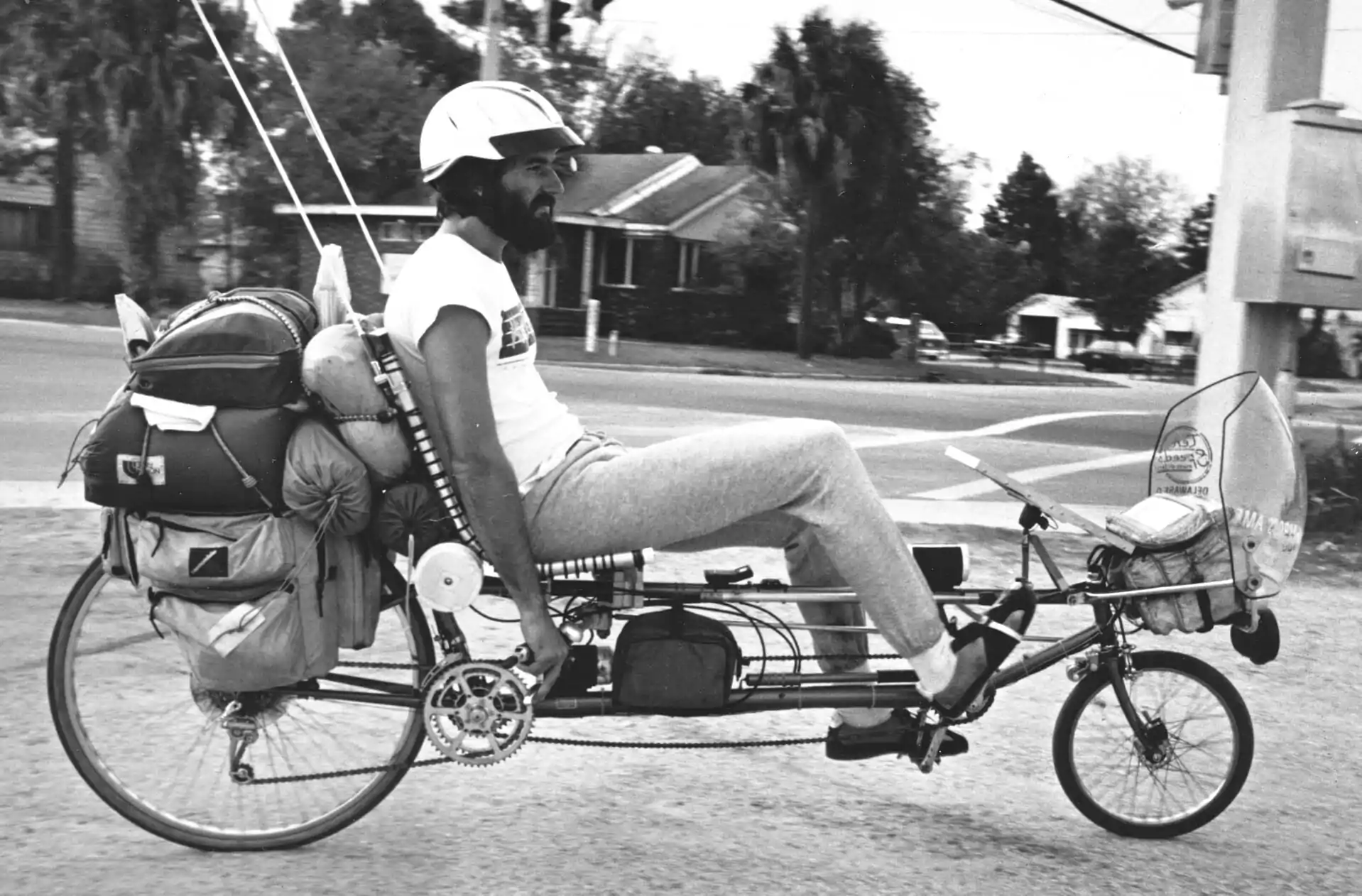
A.k.a. Those original ‘80s/‘90s solar-powered computer bikes whose names I always forget.
The names I’m looking for are… Winnebiko and BEHEMOTH, created by Technomad Steven K. Roberts, a.k.a. microship. He later built boats that were even more ridiculously geeked-out than his bikes.
13 Incoming
- The hidden potential of bicycles - resilience
- Living the dream on two wheels - by Ed West
- To Air Is Human — a 55-year-old takes up mountain biking (MTB)
14 References
Footnotes
I do sometimes drive, mind, but usually only when I move furniture or music gear. For that I rent a van. That cost does not factor into my calculations here, because if I owned a car it wouldn’t be a van, so I would still be renting a van to move furniture. Good options for renting vehicles where I live include GoGet
and Car Next Door↩︎