Wherein Convolutional Neural Networks Are Presented as a Topology Whose Layers Are Constructed With Finite-Impulse-Response Filters and Pooling, Receptive Fields Are Computed for Analysis, and Activations Are Visualised as High-Rank Tensors With Exploitable Regularity.
machine learning
neural nets
signal processing
Figure 1
The network topology that more or less kicked off the current revolution in computer vision and thus the whole modern neural network craze.
Convolutional nets (convnets or CNNs to the suave) are well described elsewhere. I’m going to collect some choice morsels here. Classic signal processing baked into neural networks.
There is a long story about how convolutions naturally encourage certain invariances and symmetries, although AFAICT it’s all somewhat hand-wavey.
Generally uses FIR filters plus some smudgy “pooling”.
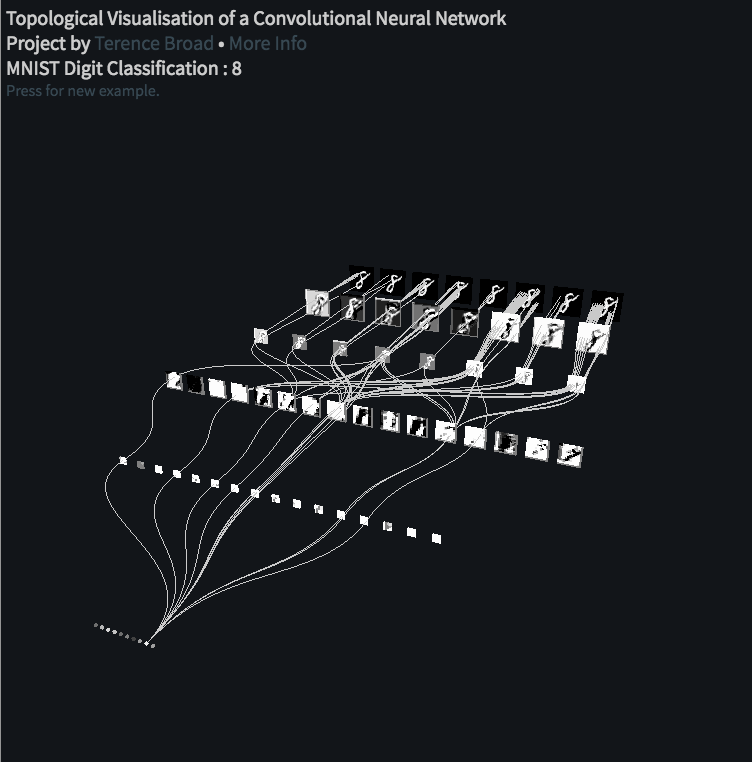
Visualising the actual activations of a convnet is an interesting data visualisation challenge, since intermediate activations often end up being high-rank tensors, but they have a lot of regularity that can be exploited, so it feels like it should be feasible.
Ronneberger, Fischer, and Brox. 2015. “U-Net: Convolutional Networks for Biomedical Image Segmentation.” Edited by Nassir Navab, Joachim Hornegger, William M. Wells, and Alejandro F. Frangi. Medical Image Computing and Computer-Assisted Intervention – MICCAI 2015. Lecture Notes in Computer Science.