Neural codecs and compression algorithms
Neural bandwidth reduction
2020-04-23 — 2026-08-09
Wherein Neural Networks Are Enlisted to Compress Images and Audio, Notably an Audio Codec Folding Frozen HuBERT or WavLM Features Into Its Residual Codebooks So Tokens Carry Semantic, Not Merely Spectral, Meaning.

Not compressing neural networks themselves, but using them to compress other things. This means using neural nets to reconstruct signals (images, audio, video) with low error from a small (in bits) summary, especially alongside existing noisy data transmission pipelines. Maybe we could even try both at once and think about minimum description length. That might be interesting.
- Image Compression with Neural Networks – Google AI Blog
- mlomnitz/DiffJPEG
- rshin/differentiable-jpeg: Code for “JPEG-resistant Adversarial Images”
1 Audio codecs
Neural networks are in audio codecs now. Originally they looked attractive for their compact bitrates, as in the Descript Audio Codec (code) (Kumar et al. 2023) which claimed a 90× compression factor for CD-quality audio.
We might also want the encodings to be a convenient space for generative audio models to predict over. In which case, we want the tokens to be “semantically meaningful” rather than just “spectrally accurate”.
X-Codec (Ye et al. 2024) attempts to achieve this. Alongside the usual acoustic encoder it runs a frozen self-supervised speech model — HuBERT or WavLM — and folds its features in before quantization, so the residual codebooks carry semantic content rather than only spectral detail. Fancy new generative models like YuE generate over X-Codec tokens, for example.
transformers now ships it as a first-class XcodecModel, so trying it is easy:
from transformers import XcodecModel, AutoFeatureExtractor

model = XcodecModel.from_pretrained("hf-audio/xcodec-hubert-general-balanced")
extractor = AutoFeatureExtractor.from_pretrained("hf-audio/xcodec-hubert-general-balanced")
codes = model.encode(audio, bandwidth=4)   # 8 codebooks; 0.5 kbps gives 1
The checkpoints differ in which semantic model they wrap and what they saw:
| Checkpoint | Semantic model | Domain | Training data |
|---|---|---|---|
xcodec-hubert-librispeech |
facebook/hubert-base-ls960 |
speech | LibriSpeech |
xcodec-wavlm-mls |
microsoft/wavlm-base-plus |
speech | MLS English |
xcodec-wavlm-more-data |
microsoft/wavlm-base-plus |
speech | MLS English + internal |
xcodec-hubert-general |
ZhenYe234/hubert_base_general_audio |
general audio | 200k hours internal |
xcodec-hubert-general-balanced |
ZhenYe234/hubert_base_general_audio |
general audio | more balanced |
NB: XCodec2 is a separate, later model, not a checkpoint in the table above. Audex uses the two for different jobs — XCodec1 for text-to-audio, XCodec2 for speech — which is easy to conflate when reading its setup instructions.
2 Images via vector embeddings
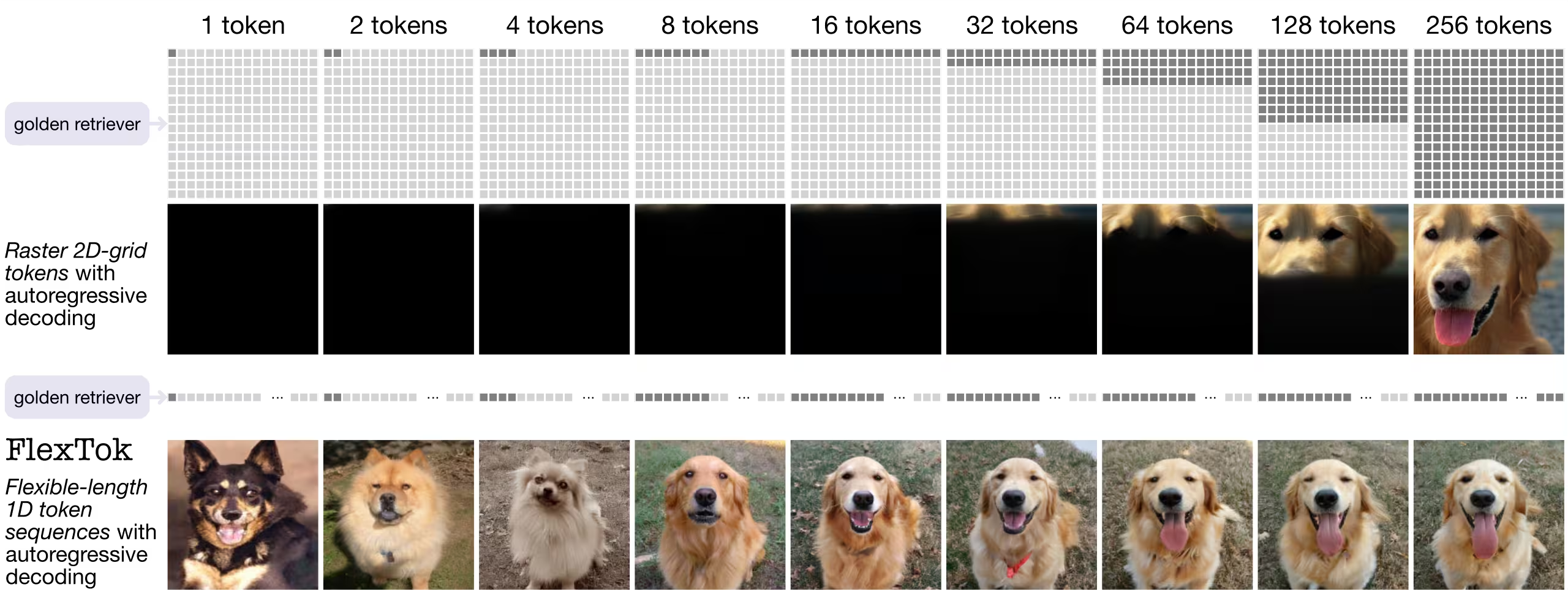
Thanks to the success of vector embeddings we can frequently represent images in a weird vector space which looks suggestively like classic encodings. In NLP, though, the embeddings are usually larger than the original text, so can we actually compress this way?
Maybe. There have been a bunch of works in that domain recently (Duggal et al. 2024; Miwa et al. 2025; Yan et al. 2025). The most viral one is (Bachmann et al. 2025), which has an elegant demonstration.